PPC Advertising in India: Complete Budget, Platform & ROI Guide for 2026
Complete PPC advertising guide for Indian businesses. Google Ads cost, CPC benchmarks by industry, budget planning, platform comparison, and ROI tracking — updated for 2026.
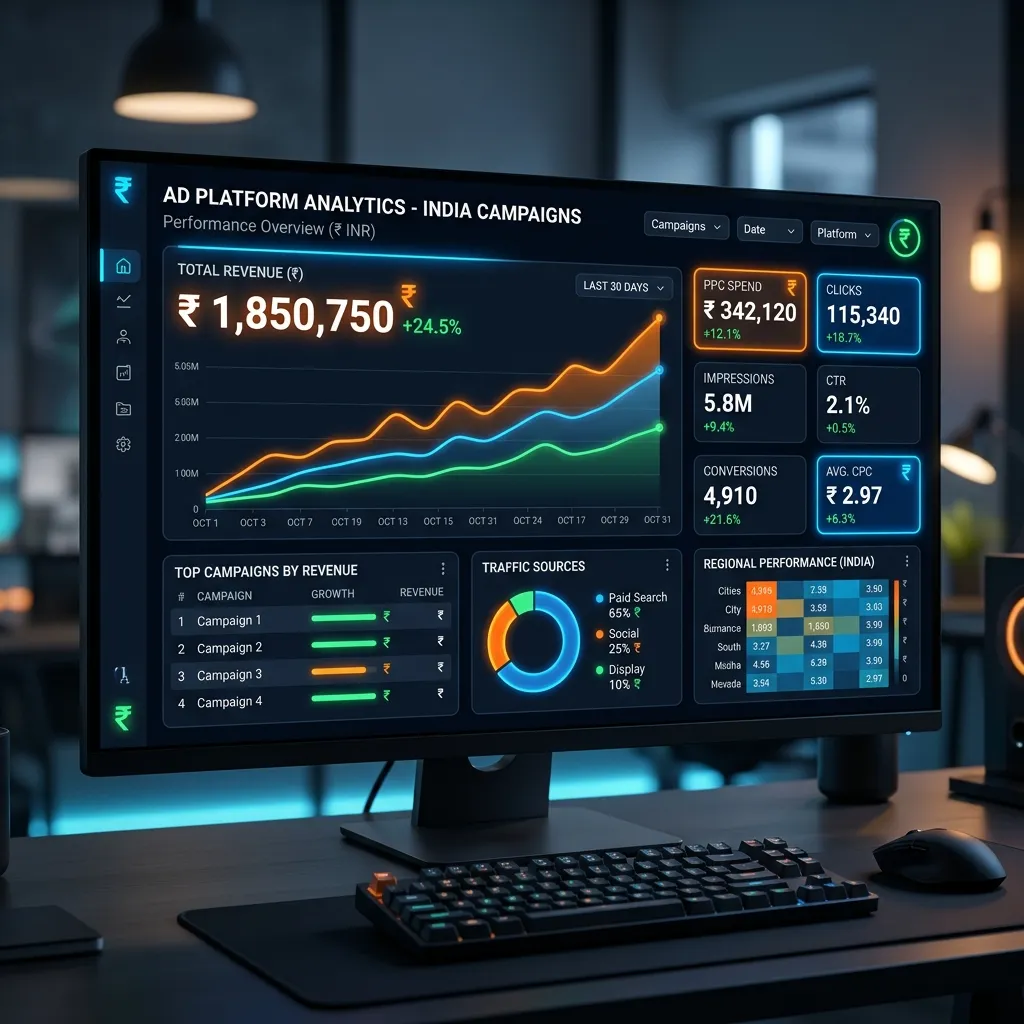
Quick answer: PPC advertising in India costs ₹5-₹500 per click depending on your industry, with a minimum effective monthly budget of ₹15,000-₹30,000. Google Ads captures high-intent buyers, Meta Ads builds brand awareness, and LinkedIn Ads generates B2B leads. The average conversion rate across industries is 2.55%, and businesses with proper tracking see ₹3-₹5 in revenue for every ₹1 spent.
India’s digital advertising market hit ₹49,000 crore in 2025 and is projected to grow 15% to ₹56,400 crore in 2026 (Ipsos). Digital has overtaken television as the largest ad channel, commanding 44% of total ad spend. Mobile accounts for 78% of digital ad expenditure.
Yet most businesses waste 30-50% of their PPC budget. Not because PPC doesn’t work — because they set it up wrong. Wrong platform, wrong keywords, wrong landing pages, no conversion tracking. This guide fixes that.
How PPC Pricing Actually Works
PPC platforms use a real-time auction system. Every time someone searches a keyword, the platform runs an auction in milliseconds to decide which ads show and in what order.
Your cost per click depends on three factors:
Your maximum bid. The highest amount you’re willing to pay for a click. Set this based on what a customer is worth to your business, not what you’d like to spend.
Quality Score (Google) or Relevance Score (Meta). Google rates your ad relevance, landing page experience, and expected click-through rate on a scale of 1-10. A higher Quality Score lowers your CPC. Two advertisers bidding the same amount can pay very different prices. Improving your Quality Score from 5/10 to 9/10 can cut your CPC by 30-50%.
Competition. More advertisers bidding on the same keyword drives the price up. Insurance keywords in India cost ₹310-₹460 per click because the customer lifetime value justifies it. E-commerce keywords cost ₹3-₹20 because margins are thinner.
Google Ads CPC Benchmarks by Industry in India
Here are 2026 CPC ranges for major Indian industries, drawn from Google Keyword Planner data:
| Industry | Average CPC (₹) | Recommended Monthly Budget | Why It Sits Here |
|---|---|---|---|
| Insurance | ₹310 - ₹460 | ₹40,000+ | Highest customer LTV |
| Education | ₹295 - ₹385 | ₹25,000+ | High course fees, long decision cycle |
| Real Estate | ₹50 - ₹330 | ₹40,000+ | Hyperlocal, high deal value |
| Finance / Lending | ₹65 - ₹270 | ₹40,000+ | High LTV, heavy competition |
| B2B SaaS / IT | ₹205 - ₹255 | ₹30,000+ | High contract value |
| Healthcare | ₹95 - ₹210 | ₹30,000+ | High-ticket procedures |
| Legal | ₹50 - ₹130 | ₹50,000+ | High case value |
| Home Services | ₹25 - ₹75 | ₹15,000+ | Moderate ticket, high volume |
| Travel | ₹14 - ₹30 | ₹20,000+ | Thin margins, OTA-dominated |
| E-commerce / Retail | ₹3 - ₹20 | ₹20,000+ | Shopping-driven, high volume |
Your actual CPC will land somewhere in these ranges depending on keyword intent, location targeting (metros cost more), and your Quality Score. The one factor you control directly is Quality Score — and it makes the biggest difference.
Choosing the Right Platform
Businesses waste money running the wrong campaign type for their goal. Here’s how to match platform to objective:
Google Ads Search — For capturing demand. Someone searches “best digital marketing agency in Hisar” and your ad appears. Highest intent, highest conversion rate (2.55% average across industries). Best for: lead generation, sales, service bookings.
Google Ads Shopping — For e-commerce. Product images, prices, and reviews appear directly in search results. Average CTR is higher than text ads. Best for: online stores with physical products.
Google Display Network — For retargeting and brand awareness. Reach people who visited your site but didn’t convert. Low CPC (₹3-₹15) but lower intent. Best for: staying top-of-mind while prospects research.
Meta Ads (Facebook & Instagram) — For discovery. People aren’t searching for you — they’re scrolling. Meta’s targeting by interests, behaviours, and lookalike audiences makes it powerful for reaching new customers. Best for: visual products, B2C, local businesses, retargeting.
LinkedIn Ads — For B2B. Target by industry, job title, company size, and seniority. CPC is higher (₹150-₹500) but lead quality is strong. Best for: enterprise software, consulting, professional services, high-ticket B2B.
YouTube Ads — For video content. 15-30 second skippable ads targeting specific audiences. Low CPV (cost per view). Best for: brand stories, product demos, explainer videos.
Most of our clients allocate 50-60% of budget to Google Ads, 30-40% to Meta, and the remainder to LinkedIn or YouTube based on their industry and goals. Start with one platform, master it, then expand.
Budget Planning That Makes Sense
A common mistake: setting a budget without understanding the math behind it. Here’s how to calculate what you need:
Step 1: Determine your target cost per lead (CPL). If your product sells for ₹10,000 and you want a 5:1 ROAS, your maximum CPL is ₹2,000.
Step 2: Divide CPL by your expected conversion rate. If your CPL target is ₹2,000 and your historical conversion rate is 3%, you can afford a CPC of ₹60 (₹2,000 × 0.03).
Step 3: Multiply CPC by expected clicks to reach your lead target. Need 50 leads per month? At 3% conversion rate, you need 1,667 clicks. At ₹60 CPC, that’s ₹1,00,000 per month.
If that number exceeds your budget, you have three options: target lower-competition keywords (long-tail), improve your landing page to increase conversion rate, or adjust your ROAS expectations.
Minimum budgets by business type:
- Local service (single city): ₹15,000-₹25,000/month
- E-commerce: ₹20,000-₹40,000/month
- B2B lead generation: ₹30,000-₹60,000/month
- Real estate: ₹40,000-₹80,000/month
- Finance / insurance: ₹40,000-₹1,00,000/month
Below ₹15,000/month, campaigns struggle to collect enough conversion data for Google’s Smart Bidding algorithms to optimise effectively.
Keyword Research: Finding the Right Terms for Indian Audiences
The difference between a profitable PPC campaign and a money pit often comes down to keyword selection. Indian markets have specific search behaviour patterns that differ from Western markets.
Use Indian English spellings and phrasing. Indian users search differently than American or British users. “AC repair” gets more searches than “air conditioner repair” in India. “Best hospital near me” outperforms “top healthcare facility.” Use Google Keyword Planner with India location targeting and Hindi + English language settings to capture the full search volume.
Prioritise long-tail keywords for smaller budgets. A business with ₹30,000/month cannot compete with national brands on “insurance” (₹400 CPC). But “best term insurance for 35 year old in Pune” costs ₹80-120 CPC and converts at 2-3x higher rates because the intent is specific. Build your keyword list from bottom to top — start with specific long-tail terms, expand to broader terms as budget allows.
Mine your search terms report weekly. After 2-3 weeks of running campaigns, Google’s search terms report shows the actual queries people typed before seeing your ad. You will find surprising queries you never thought to bid on — add high-performing ones. You will also find irrelevant terms — add them as negative keywords immediately to stop wasting budget.
Include local intent modifiers. Adding “near me,” “in [city],” “in [area]” to your keyword strategy captures local buyers. For a Hisar-based business, bidding on “web developer in Hisar” costs less and converts better than bidding on “web developer India.” Google’s location targeting combined with local intent keywords is the most cost-efficient strategy for service-area businesses.
Mobile PPC: Capturing the 78%
Mobile accounts for 78% of digital ad spend in India (Ipsos 2026). If your campaigns are designed for desktop, you are optimising for the minority.
Use mobile-preferred ad formats. Responsive search ads automatically adjust to screen size, but you should set mobile-preferred final URLs that point to mobile-optimised pages. Call-only ads let users tap to call directly from the search results — ideal for service businesses where the conversion is a phone call, not a form fill.
Shorten everything for mobile screens. Headlines get cut off at 2 lines on most phones. The first 20 characters of your headline must communicate the complete value proposition. Body copy should be half the length of desktop versions. Mobile users scan faster and have less patience — every word must earn its place.
Optimise landing pages for mobile conversion. A mobile landing page must load in under 3 seconds on 4G. Forms should use mobile-friendly inputs — phone number fields that trigger the numeric keypad, pin code fields with limited length, and auto-detect location buttons. Click-to-call buttons and WhatsApp chat widgets outperform forms on mobile by 40-60%.
Track mobile-specific conversion actions. Calls from ads, WhatsApp inquiries, and direction clicks are common mobile conversions that desktop-focused tracking misses. Set up call tracking and click-to-WhatsApp tracking as conversion actions. Without them, your mobile ROAS appears artificially low and you underinvest in your highest-performing channel.
Ad Copy That Actually Gets Clicks
Good ad copy doesn’t sell the product. It sells the click. Your goal is to get someone to visit your landing page — that’s where the sale happens.
Write ads that match search intent. If someone searches “web development company in Hisar,” your ad headline should say exactly that. Google rewards relevance with higher Quality Scores and lower CPC. Match the user’s words, not your marketing jargon.
Include numbers and specifics. “Starting at ₹15,000” outperforms “Affordable pricing.” “Serving 80+ clients across 12 countries” outperforms “Trusted by clients worldwide.” Specifics build credibility.
Use every character of your headlines. Google Search ads have three headlines (30 characters each). Use all of them. First headline: the keyword match. Second: the benefit or offer. Third: social proof or urgency.
Add sitelink extensions. These extra links below your ad take users to specific pages — services, pricing, contact, case studies. Ads with sitelink extensions see 10-15% higher click-through rates.
Landing Pages: The Piece Everyone Ignores
Here’s what happens when most businesses run PPC: they send traffic to their homepage. The homepage is designed for general browsing. Someone who clicked “SEO services Hisar” lands on a page that talks about web development, app development, and digital marketing. They leave. The click is wasted.
Match the ad to the page. If your ad promises “SEO services in Hisar starting at ₹15,000,” the landing page must deliver exactly that. Same headline. Same offer. Same pricing. A mismatch increases bounce rates and kills Quality Score.
Remove navigation menus. A PPC landing page should have one goal — convert. Remove the header menu, footer links, and sidebar distractions. Leave only the form or CTA.
Put the form above the fold. Don’t make users scroll to find where to submit their information. Name, phone, email, and a brief message field. Save detailed questions for the discovery call.
Add trust signals near the form. Client logos, testimonials, certification badges, and guarantee icons. Visitors who see trust signals convert at significantly higher rates than those who don’t.
One of our clients was spending ₹80,000/month on Google Ads with a 1.2% conversion rate. We rebuilt their landing pages — matched ad copy to page content, removed navigation, added testimonials. Conversion rate went to 3.8%. Same budget, 3x the leads.
Tracking ROI: Set This Up Before You Spend a Rupee
Running PPC without conversion tracking is like flying blind. You know you’re spending money but have no idea what’s working.
Install the Google Ads conversion tracking tag. This small snippet of code fires when someone completes a desired action — form submission, phone call, purchase. It tells Google which keywords and ads actually drive results.
Set up Google Analytics 4 goals. GA4 tracks the full user journey — where visitors come from, what they do on your site, where they drop off. Link it to Google Ads for cross-platform reporting.
Track phone calls. Many Indian businesses get leads by phone, not form. Set up call tracking to attribute phone leads to specific campaigns. Without it, your Google Ads dashboard underreports conversions by 30-50%.
Define your primary metric. For lead generation: cost per lead (CPL). For e-commerce: return on ad spend (ROAS). For brand awareness: cost per thousand impressions (CPM). Pick one north-star metric and optimise everything toward it.
Measure what happens after the lead. The ultimate ROI isn’t cost per lead — it’s cost per customer. Track lead-to-customer conversion rates and average customer lifetime value. A campaign with a high CPL but high close rate can outperform a low-CPL campaign that generates unqualified leads.
Common Mistakes That Bleed Budget
Running ads without negative keywords. If you sell premium services, add “free” and “cheap” as negative keywords. Otherwise, you pay for clicks from people who will never buy. Review your search terms report weekly and add irrelevant terms as negatives.
Targeting too broadly. India is not one market. Someone in Mumbai searching for “web developer” has different intent than someone in Hisar. Target by city, radius, or pin code for local services. Use state-level targeting for B2B only if your capacity allows statewide delivery.
Using the same budget for every campaign. Allocate more budget to campaigns that convert and less to campaigns that build awareness. A common split: 70% to conversion campaigns, 20% to retargeting, 10% to testing new audiences.
Setting and forgetting. PPC campaigns need weekly attention. Pause underperforming keywords, adjust bids on top performers, refresh ad copy monthly to prevent fatigue, and review audience targeting. The difference between a managed and unmanaged campaign is usually 2-3x in ROAS.
A/B Testing: How to Run Campaigns That Teach You Something
Running PPC without A/B testing means you’re guessing what works. Here is how to test systematically so every campaign teaches you something useful.
Test one variable at a time. Change the headline, keep everything else identical. Run until you have statistical significance — minimum 100 conversions per variation. Testing two different headlines AND a different image AND a different landing page tells you nothing about which change caused the result.
What to test in order of impact:
- Landing pages produce the biggest conversion lifts (we have seen 2-3x improvements from a single redesign)
- Headlines matter more than body copy — the first 30 characters determine whether someone reads the rest
- Call-to-action buttons — “Get a Free Quote” vs “Book a Call” vs “Start Now”
- Offer and pricing — free consultation vs discount vs free ebook
- Audience targeting — broad vs narrow, different cities, different job titles
- Ad extensions — sitelinks, callouts, structured snippets can lift CTR by 10-30% individually
Run every test for at least 7 days. Campaign performance varies by day of week. A campaign that looks terrible on Sunday might convert 3x better on Tuesday. Seven days captures a full weekly cycle. Do not make decisions based on less than 100 conversions per variation.
Document everything. Create a simple spreadsheet with test name, start date, end date, variations tested, sample size, winner, and conversion lift percentage. Six months of documented tests become a proprietary playbook for your business — you will know exactly what messaging works for your audience.
Advanced Strategies for Scaling Beyond the Basics
Once your foundation campaigns are producing consistent results, these strategies help you scale without destroying ROAS.
Remarketing to engaged visitors. Install remarketing pixels on day one. Target people who visited your pricing page but didn’t convert with a specific offer. Target people who read your blog but never filled a form with educational content. Remarketing campaigns typically convert at 2-3x the rate of cold audience campaigns.
Lookalike audiences from your best customers. Upload your highest-value customer list to Meta Ads or Google Ads. The platform finds people with similar characteristics — demographics, behaviours, interests — to your existing customers. Start with a 1% lookalike (closest match) and expand to 3-5% as you scale budget.
Cross-platform attribution. Most customers interact with multiple channels before converting. They see a Facebook ad, Google your brand, read a blog post, then convert through a remarketing ad. Single-platform attribution overcredits the last click and undercredits everything else. Use GA4’s cross-channel attribution reports or a tool like Triple Whale to understand the full customer journey.
Seasonal campaign planning. Map your business to the Indian calendar — festive season (Diwali, Dussehra), wedding season, back-to-school, summer vacations. Prepare campaigns 4-6 weeks in advance with specific creatives, landing pages, and budget allocations. Seasonal campaigns see 30-50% lower CPCs when started early because early bidding competition is lower.
Scaling budget without breaking ROAS. Increase budget by 20% per week on winning campaigns. Monitor cost per conversion closely for 3-5 days after each increase. If CPL spikes more than 15%, pause the increase and let the campaign stabilise. The goal is to find the maximum budget your campaign can absorb before diminishing returns set in.
What to Expect in Your First 90 Days
Month 1 — Learning phase. Google’s algorithms need 30-50 conversions to optimise Smart Bidding. CPCs are higher. Conversion rates are lower. Do not make major changes. Let the system collect data.
Month 2 — Optimisation phase. Review search terms reports. Add negative keywords. Pause low-performing ad groups. Increase bids on high-converting keywords. Test 2-3 new ad variations per ad group.
Month 3 — Scaling phase. Gradually increase budget on winning campaigns by 20% per week. Expand to new keywords that surfaced in search terms reports. Test new audiences for retargeting. By month three, you should see consistent CPL and ROAS that match your targets.
PPC is the fastest way to get customers when you need them. But speed comes from setup, not spend. Fix the foundations — platform choice, Quality Score, landing pages, conversion tracking — and the results follow.
Need help setting up PPC campaigns that actually produce leads? Our team handles the full stack — strategy, ad copy, landing page design, conversion tracking, and ongoing optimisation. We’ve managed campaigns across 12 countries and 80+ clients. The blueprint is above. We handle the execution.
Related Articles
Google Ads & PPC Management Services in Hisar — Get More Customers Fast
Need Google Ads management in Hisar? We run profitable PPC campaigns that generate leads within 24 hours. Google Ads, Facebook Ads & LinkedIn Ads. Starting at ₹8,000/month.

Social Media Marketing Packages in Hisar — Grow Your Business on Instagram, Facebook & LinkedIn
Social media marketing packages for Hisar businesses starting at ₹5,000/month. Instagram, Facebook, and LinkedIn management with content creation, posting, and paid ads.
LinkedIn Marketing for B2B Businesses in India: Complete Strategy Guide 2026
Learn how to generate B2B leads on LinkedIn in 2026. Complete guide covering organic content strategy, LinkedIn Ads, profile optimization, and proven tactics for Indian businesses.
Get Professional PPC Services
PPC campaigns delivering 4.2× ROAS — Google Ads, Meta, LinkedIn, TikTok, and Microsoft Ads with continuous optimisation.
