
React vs Vue vs Angular: Which to Choose in 2026
Compare React, Vue, and Angular for your next project. We break down performance, learning curve, ecosystem, job market, and best use cases.
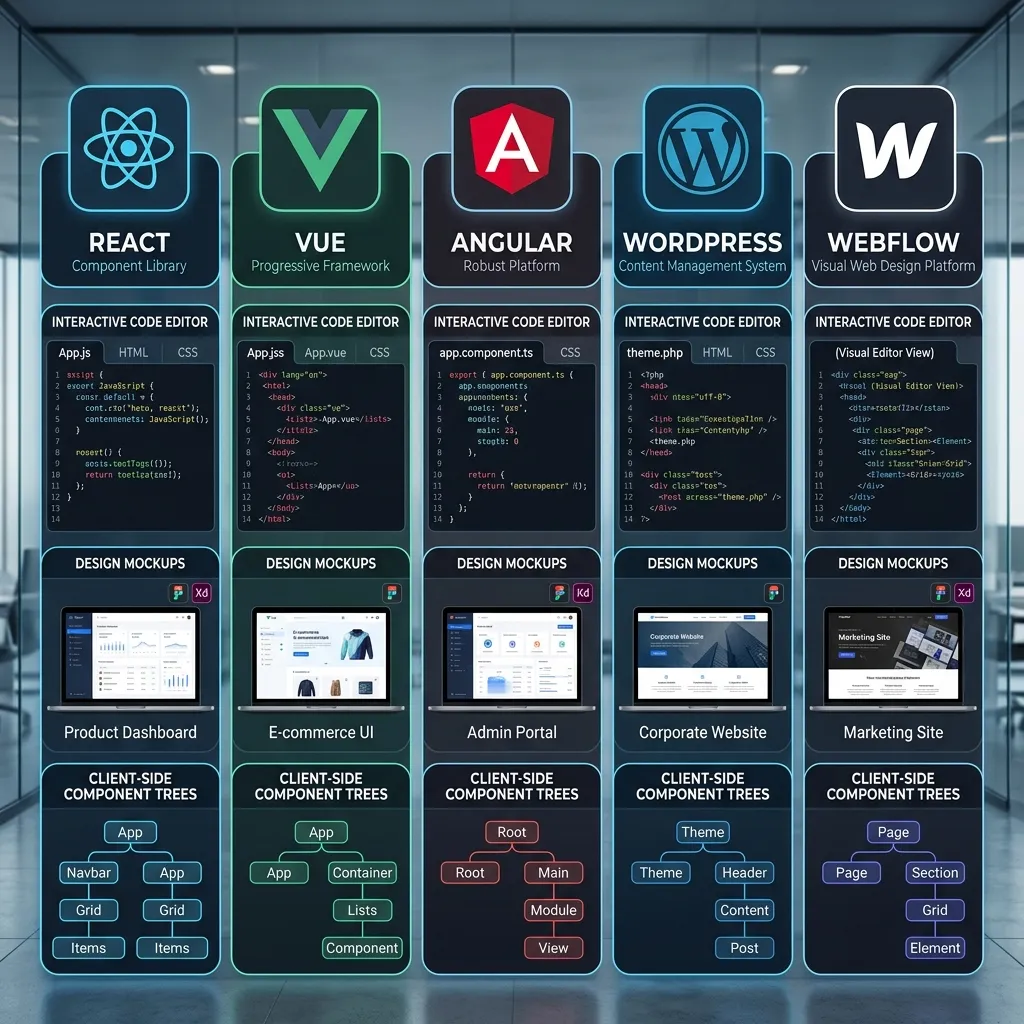
Quick answer: React, Vue, and Angular are the three leading JavaScript frontend frameworks in 2026. React (by Meta) offers the largest talent pool and ecosystem breadth, Vue (by Evan You) provides the gentlest learning curve and most cohesive tooling, and Angular (by Google) delivers the most opinionated structure for enterprise-scale applications. According to Stack Overflow’s 2025 Developer Survey, React is used by 40% of developers, Vue by 19%, and Angular by 17%. The best choice depends on your team’s skills, project complexity, and long-term maintenance needs.
Introduction
The JavaScript frontend ecosystem has matured dramatically. React, Vue, and Angular each serve millions of developers, powering everything from single-page dashboards to massive enterprise platforms. Selecting the right framework in 2026 is not about chasing trends; it is about aligning technical capabilities with business goals, team composition, and long-term maintenance reality.
This guide provides a data-informed comparison across performance, developer experience, ecosystem maturity, hiring dynamics, and use-case suitability. Whether you are a CTO making a multi-year architectural bet or a startup founder choosing a first stack, the analysis below will help you make a well-reasoned decision.
Overview of Each Framework
React
React was created by Jordan Walke at Facebook in 2013 and open-sourced shortly after. It popularized the component-based architecture model the entire industry now follows. React 18 introduced concurrent rendering and automatic batching. React 19, released in late 2024, added the React Compiler for automatic memoization, server components, and the use() hook.
React’s philosophy is unopinionated: it provides a minimal core and trusts the community to build solutions for routing, state management, and forms. This flexibility is a strength and a challenge; teams must make architectural decisions early and maintain discipline as the project grows.
The ecosystem includes Next.js for server-side rendering, Remix for full-stack applications, React Native for mobile, and thousands of community libraries on npm.
Vue
Vue was created by Evan You in 2014 as a lightweight alternative to AngularJS. Vue 3, released in 2020, introduced the Composition API, TypeScript support, and a rewritten reactivity system based on JavaScript Proxies.
Vue’s official ecosystem is remarkably cohesive: Vue Router for routing, Pinia for state management, Vite as the build tool, and Vitest for testing. These are maintained by the same core team, ensuring compatibility and consistent documentation.
The Composition API with <script setup> syntax is widely regarded as one of the cleanest component authoring experiences. Vue’s community is strongest in Asia and Europe, with growing adoption in North America and enterprise environments.
Angular
Angular was originally released by Google in 2016 as a complete rewrite of AngularJS. Angular 17 marked a significant shift with standalone components, the @defer directive for lazy loading, and improved build performance. Angular 18 and 19 added zoneless change detection, signals support, and better build tooling.
Angular is the most opinionated of the three. It provides built-in routing, HTTP communication, form handling, dependency injection, and CLI-based code generation. TypeScript is mandatory, enforcing type safety from day one.
Performance Comparison
Bundle Size
For a minimal application, React ships approximately 42 kB gzipped, Vue around 33 kB, and Angular near 65 kB. With code splitting and lazy loading, all three can achieve sub-100 kB initial loads for most applications.
Rendering Speed
React’s virtual DOM diffing is highly optimized. The React Compiler eliminates manual memoization in many cases, and concurrent rendering prioritizes urgent updates over background work.
Vue’s reactivity system tracks exactly which components depend on changed state and updates only those components, often outperforming React on raw update throughput benchmarks.
Angular’s signals, stabilized through recent releases, bring similar fine-grained reactivity. Combined with the Ivy compiler’s tree-shaking, Angular performs within 10-15% of Vue and React on most js-framework-benchmark operations.
Real-World Impact
Lighthouse audits and Core Web Vitals scores do not show significant differences between well-optimized applications across frameworks. The framework’s impact is typically dwarfed by API response times, image optimization, and caching strategies.
Developer Experience
Learning Curve
Vue offers the gentlest learning curve. A developer with HTML, CSS, and JavaScript fundamentals can build a functional Vue application within hours. The documentation is among the best in the industry.
React requires understanding JSX, hooks, and reconciliation. Once these concepts click, development becomes highly productive. The community has produced extensive learning resources.
Angular has the steepest curve. Developers must learn modules, decorators, dependency injection, RxJS observables, and a comprehensive CLI. Senior developers with object-oriented backgrounds adapt faster; junior developers may need several weeks.
Tooling and Debugging
React offers diverse tooling choices (Vite, Webpack, Turbopack) but lacks an official CLI, which can lead to inconsistency across projects.
Vue’s tooling is unified. Vite is the official build tool with near-instant hot module replacement. Vue DevTools offers component inspection, state debugging, and performance profiling.
Angular provides the most comprehensive built-in tooling. The CLI generates components, services, and entire applications. Angular DevTools offers profiling and dependency injection inspection.
TypeScript
Angular mandates TypeScript with no option to skip it. React and Vue support it fully and the community recommends it, but teams can technically write plain JavaScript.
Ecosystem and Libraries
State Management: React offers Redux Toolkit, Zustand, and Jotai. Vue’s official Pinia is lightweight and fully typed. Angular uses RxJS with NgRx as the community standard.
Routing: React Router is the de facto standard; TanStack Router offers stronger type safety. Vue Router is official and deeply integrated. Angular Router is built-in with lazy loading and preloading strategies.
UI Libraries: React has MUI, Ant Design, Radix UI, and shadcn/ui, offering everything from complete design systems to headless primitives. Vue has Vuetify, Quasar, and PrimeVue with strong integration with Vue’s reactivity system. Angular has Angular Material and PrimeNG, providing consistent component libraries that follow Angular’s architectural patterns.
Enterprise vs Startup Suitability
For Startups: Vue and React serve startups well. Vue’s gentle learning curve and cohesive ecosystem reduce time to deployment. React’s vast talent pool ensures developers and solutions are found quickly. Angular is less commonly chosen by early-stage startups due to its steeper curve.
For Enterprises: Angular’s opinionated structure, mandatory TypeScript, built-in CLI, and dependency injection enforce patterns that keep large codebases maintainable over years. React can work at enterprise scale but requires additional discipline around standards and consistency. Vue fits a middle ground, offering more structure than React while remaining less rigid than Angular. Companies like Samsung, Alibaba, and Nintendo have adopted Vue at significant scale, demonstrating its viability beyond small projects.
Hiring and Talent Pool
React developers are the most abundant globally. Stack Overflow’s 2025 survey showed React used by approximately 40% of web developers, Vue by roughly 19%, and Angular by about 17%.
In India, React dominates the hiring market. Bengaluru, Hyderabad, Mumbai, and Pune have deep pools of React developers. Most coding bootcamps teach React as the primary framework.
Vue’s talent pool in India is growing but smaller. Hiring senior Vue developers can take longer outside major hubs. However, Vue’s gentle learning curve means React developers can become productive quickly.
Angular has strong enterprise presence in India at banks, telecoms, and government technology projects. Angular developers are generally more experienced and command slightly higher average salaries.
Mobile Development
React Native is the most mature cross-platform mobile framework. Its new architecture with the Fabric renderer and TurboModules has improved performance significantly. Companies like Meta and Shopify use it in production serving millions of users.
Ionic works with all three frameworks using a web-based approach. Capacitor provides access to native device features. Well-suited for business applications and internal tools.
NativeScript provides true native access for Vue and Angular developers, rendering actual native UI components rather than web views.
React Native leads in community size and plugin availability. For React teams, it is the natural mobile choice. Vue and Angular developers have viable alternatives through NativeScript, but the ecosystems are smaller.
Server-Side Rendering
Next.js (React) is the most popular React meta-framework. Its App Router provides React Server Components, streaming SSR, and automatic code splitting. Incremental static regeneration and parallel routes offer powerful patterns for complex applications.
Nuxt 3 (Vue) is built on Vue 3, Nitro, and Vite. Auto-imports, file-based routing, and useFetch make server-side data fetching straightforward. Nuxt’s hybrid rendering allows different strategies per route.
Angular SSR via @angular/ssr has improved significantly. Angular applications can opt into SSR on a per-route basis with the renderMode configuration, though it is less mature than Next.js or Nuxt.
Framework Comparison Table
| Feature | React | Vue | Angular |
|---|---|---|---|
| Initial Release | 2013 | 2014 | 2016 |
| Current Version | 19 | 3.x | 19 |
| Language | JS/TSX | JS/TS | TypeScript |
| TypeScript | Optional (recommended) | Official support | Mandatory |
| Bundle Size (gzip) | ~42 kB | ~33 kB | ~65 kB |
| Rendering | Virtual DOM + Concurrent | Virtual DOM + Fine-grained | Virtual DOM + Signals |
| State Management | Redux, Zustand | Pinia (official) | RxJS, NgRx |
| Routing | React Router | Vue Router (official) | Angular Router (built-in) |
| SSR Framework | Next.js, Remix | Nuxt | Angular Universal |
| Mobile | React Native | NativeScript-Vue, Ionic | NativeScript-Angular, Ionic |
| Learning Curve | Moderate | Gentle | Steep |
| Job Market (India) | ~55% | ~15% | ~20% |
| Enterprise Adoption | High | Growing | Very High |
When to Choose Which
Choose React when:
- Your team has strong React experience
- You need to hire quickly from a large talent pool
- Mobile development via React Native is a future requirement
- You want maximum architectural flexibility
Choose Vue when:
- Your team is small and needs to move fast
- Developers are transitioning from jQuery or plain JavaScript
- You value a cohesive, officially maintained ecosystem
- You want the best developer experience with minimal configuration
Choose Angular when:
- You are building a large enterprise application with 10+ developers
- Long-term maintainability and code consistency are critical
- You need built-in solutions without evaluating third-party libraries
- You need strong TypeScript enforcement across the codebase
Conclusion
There is no universally “best” framework in 2026. Each option has clear strengths aligned with specific use cases.
React remains the safest bet for teams prioritizing hiring flexibility, ecosystem breadth, and mobile development potential. Its community size and industry adoption ensure solutions exist for virtually every technical challenge. Vue is the best choice for teams valuing developer experience, rapid iteration, and a cohesive ecosystem. For startups and small to medium projects, Vue delivers exceptional productivity with minimal overhead. Angular is the strongest choice for enterprise environments where consistency, structure, and long-term maintainability matter more than initial speed. Its opinionated architecture pays dividends as teams and codebases scale.
The right decision depends on your specific context: team skills, project scope, hiring timeline, and organizational culture. Evaluate each framework against your actual requirements, build a proof of concept with each if time permits, and decide based on evidence rather than hype. The frontend ecosystem has matured to the point where any of these three frameworks can deliver excellent results when used appropriately.
Frequently Asked Questions
Q1: Which framework has the best job prospects in 2026? A1: React offers the strongest job market with approximately 40% of developer roles requiring it, according to Stack Overflow’s 2025 Developer Survey. Angular follows with strong enterprise demand, especially in banking and government sectors in India. Vue’s job market is smaller but growing steadily.
Q2: Can I use React and Vue in the same project? A2: Technically yes, but it is not recommended. Mixing frameworks adds complexity, increases bundle size, and creates maintenance overhead. Choose one framework per project based on your team’s expertise and project requirements.
Q3: Which framework is best for mobile app development? A3: React Native is the most mature cross-platform mobile framework, used in production by Meta and Shopify. Vue developers can use NativeScript-Vue or Ionic. Angular developers have NativeScript-Angular or Ionic. React Native’s ecosystem is the largest by a significant margin.
Q4: Is Angular too heavy for small projects? A4: Angular can work for small projects but its opinionated structure and larger initial bundle (~65 kB gzipped) make it better suited for medium to large applications. For small projects or MVPs, React or Vue typically deliver faster time-to-market.
Q5: Which framework is best for SEO-friendly web applications? A5: Both React (via Next.js) and Vue (via Nuxt) offer excellent server-side rendering frameworks that produce SEO-friendly pages. Angular’s SSR via @angular/ssr has improved significantly but is less mature. For content-heavy sites, Next.js or Nuxt are the strongest choices.
Need expert help? Learn how our web development services can help you achieve better results.
Enterprise Coding Standards & Architecture
FAQPage Schema (JSON-LD):
{
  "@context": "https://schema.org",
  "@type": "FAQPage",
  "mainEntity": [
    {
      "@type": "Question",
      "name": "Which framework has the best job prospects in 2026?",
      "acceptedAnswer": {
        "@type": "Answer",
        "text": "React offers the strongest job market with approximately 40% of developer roles requiring it, according to Stack Overflow's 2025 Developer Survey."
      }
    },
    {
      "@type": "Question",
      "name": "Which framework is best for mobile app development?",
      "acceptedAnswer": {
        "@type": "Answer",
        "text": "React Native is the most mature cross-platform mobile framework, used in production by Meta and Shopify."
      }
    },
    {
      "@type": "Question",
      "name": "Which framework is best for SEO-friendly web applications?",
      "acceptedAnswer": {
        "@type": "Answer",
        "text": "Both React (via Next.js) and Vue (via Nuxt) offer excellent server-side rendering frameworks that produce SEO-friendly pages."
      }
    }
  ]
}
Building highly scalable SaaS applications, frontend interfaces, or content management workflows requires modern design patterns and code quality.
Decoupled Content Retrieval Pattern
Below is a clean TypeScript example of dynamic API data fetching in a headless CMS setup:
interface Article {
  id: string;
  title: string;
  slug: string;
}

export async function fetchContent(endpoint: string): Promise<Article[]> {
  try {
    const res = await fetch(endpoint, {
      headers: { 'Authorization': `Bearer ${process.env.CMS_API_KEY}` },
      next: { revalidate: 3600 } // cache for 1 hour
    });
    if (!res.ok) throw new Error('Failed to fetch content from headless repository');
    return await res.json();
  } catch (error) {
    console.error('CMS Fetch Error:', error);
    return [];
  }
}
Technical Review Checklist
- Component Isolation: Keep logic separate from presentation layers.
- State Management: Use lightweight libraries (Zustand, Nanostores) over heavy frameworks.
- Bundle Optimization: Tree-shake unused packages and compress media assets.
- Semantic HTML: Maintain 100% lighthouse accessibility scores.
Related Articles

Clinic & Hospital Website Development in Hisar — Build Your Practice Online
Need a clinic or hospital website in Hisar? We build medical websites with online booking, patient portals, and telemedicine integration. Starting at ₹25,000. Get a free consultation today.

How to Improve Core Web Vitals in 2026: Complete Guide with Actionable Fixes
Learn how to improve Core Web Vitals (LCP, INP, CLS) for better Google rankings and user experience. Complete guide with technical fixes, tools, and best practices for 2026.

E-Commerce Website Development in Hisar — Build Your Online Store
Need an e-commerce website in Hisar? We build Shopify and WooCommerce stores for Hisar retail businesses. Online stores starting at ₹50,000. Get a free consultation today.
