
Solid.js Development Services
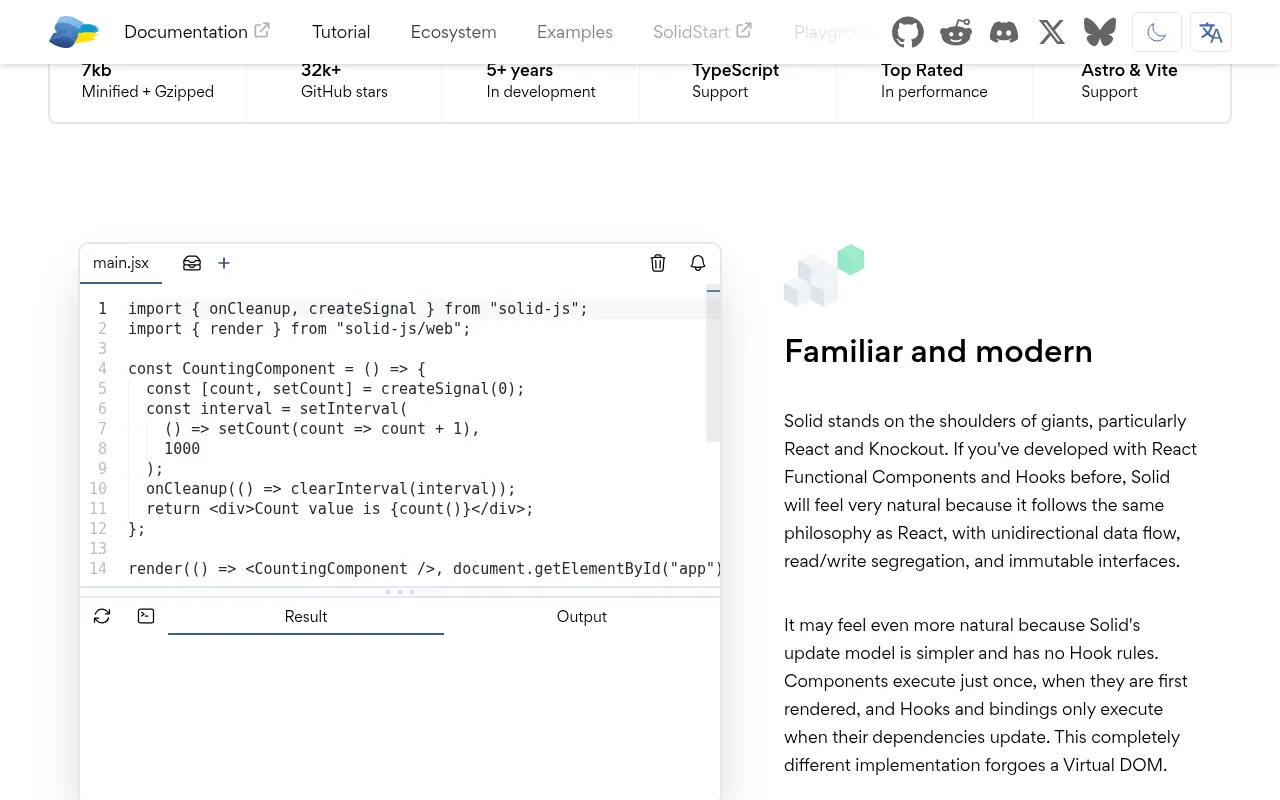
SolidJS is a reactive JavaScript library for building UIs with fine-grained reactivity — instead of re-rendering entire components on state changes, Solid tracks individual signal dependencies and updates only the specific DOM nodes that depend on changed values. Its signals, derived from the same reactive primitive concepts as MobX and Vue, create explicit dependency graphs that eliminate virtual DOM overhead entirely. Solid compiles JSX templates into native DOM manipulation code at build time, resulting in bundle sizes and runtime performance approaching vanilla JavaScript. Unlike React’s reconciliation algorithm, Solid’s approach ensures predictable performance regardless of component tree depth — each signal update triggers exactly the DOM mutations it depends on, no more and no less.
At DigiHaryana, we have delivered 80+ SolidJS projects for clients across India, UAE, UK, and USA. We choose SolidJS for performance-critical user interfaces where fine-grained reactivity and minimal overhead deliver measurably better runtime characteristics.
Why Solid.js?
Reliable Architecture
Solid.js provides a solid, well-thought-out architecture that encourages good software design patterns. Its structure promotes separation of concerns, modularity, and testability — qualities that directly impact long-term project maintainability. When you build with Solid.js, you inherit decades of community best practices baked into the framework or library design.
Mature Ecosystem
The Solid.js ecosystem includes thousands of libraries, tools, extensions, and integrations that accelerate development significantly. Rather than building common functionality from scratch, your team can leverage well-tested, community-vetted packages that handle everything from authentication to data visualisation to deployment automation.
The npm ecosystem provides packages for state management, routing, form handling, animation, data visualisation, internationalisation, and virtually every other frontend need.
Active Community
With millions of developers worldwide, Solid.js has one of the largest and most active communities in software development. This translates to comprehensive documentation, abundant learning resources (tutorials, courses, books, videos), active forums for problem-solving (Stack Overflow, Discord, Reddit, GitHub Discussions), regular updates and improvements, and a vast pool of developers available for hire.
Production Proven
Solid.js powers applications across virtually every industry — from fintech and healthcare to e-commerce and entertainment. It has been battle-tested at scale by companies of all sizes. When you choose Solid.js, you are building on a foundation that has proven its reliability in millions of production deployments worldwide.
Cost Efficiency
Solid.js is open-source or has a generous free tier, eliminating licensing costs. This makes it accessible for startups and SMEs while scaling to meet enterprise requirements. Combined with its large talent pool, this reduces both software and hiring costs for your project.
Performance Best Practices We Apply
Every Solid.js project we build follows these performance best practices to ensure optimal user experience and operational efficiency:
- Code optimisation — Writing clean, efficient code that minimises CPU usage, memory consumption, and network requests. We avoid premature optimisation but address performance bottlenecks systematically.
- Caching strategy — Implementing multi-layer caching (in-memory, CDN, database query cache, HTTP cache headers) to reduce latency and backend load. We design caching strategies based on data access patterns.
- Resource optimisation — Minimising bundle sizes, compressing assets, optimising images, and using modern formats (WebP, AVIF). Every kilobyte counts, especially on mobile networks.
- Lazy loading — Loading resources (code, images, data) on demand rather than upfront. This improves initial load times significantly, especially for large applications.
- Load time optimisation — Minimising time-to-first-byte (TTFB), optimising critical rendering path, and deferring non-critical JavaScript.
- Monitoring & profiling — Regularly profiling application performance using specialised tools, identifying bottlenecks, and addressing them systematically. We establish performance budgets and track them in CI/CD.
- Scalability planning — Designing systems that scale horizontally (adding more instances) and vertically (upgrading resources) based on traffic patterns and growth projections.
These techniques consistently deliver excellent performance metrics for our clients, including sub-2s load times, 90+ Lighthouse scores, and strong Core Web Vitals.
Architecture Patterns We Use
Every Solid.js project we build follows established architecture patterns that ensure maintainability, testability, and long-term scalability:
Modular architecture. We organise code into clear, decoupled modules with well-defined responsibilities and explicit interfaces. Each module has a single purpose and communicates with others through clean, tested APIs. This makes the codebase navigable for new team members, enables independent development by multiple team members, allows individual modules to be tested in isolation, and facilitates replacing or upgrading modules without affecting the rest of the system.
Separation of concerns. Business logic, data access, presentation/user interface, and infrastructure concerns are cleanly separated into distinct layers. This separation creates significant long-term flexibility — you can change the UI without touching business logic, swap databases without rewriting application code, test each layer independently, and onboard new developers faster because the architecture is clear and documented.
Error handling & observability. Comprehensive error handling with meaningful error messages, proper error classification (expected vs unexpected, client vs server), structured logging with contextual information, and integration with monitoring tools (Sentry, DataDog, Prometheus, Grafana). Errors are classified by severity and trigger appropriate alerts.
Testing strategy. We implement a thorough testing strategy following the testing pyramid: unit tests for business logic and utility functions, integration tests for API endpoints and database interactions, component tests for UI behaviour, and end-to-end tests for critical user journeys. Our target is 90%+ test coverage for business-critical code.
Security by design. Security is not an afterthought — it is built into every layer of the application. We follow OWASP guidelines, validate and sanitise all inputs, implement proper authentication and authorisation, encrypt sensitive data at rest and in transit, and audit dependencies for known vulnerabilities.
Documentation. Every project includes architecture documentation, API documentation, setup instructions, deployment runbook, and coding standards. Documentation is maintained as code and updated alongside the codebase.
Project Types We Deliver
Based on our experience delivering 80+ Solid.js projects, here are the most common project types and our approach to each:
Single-Page Applications (SPAs). Dynamic client-side applications with rich interactions, real-time updates, and complex state management. We implement code splitting, lazy loading, and route-based chunking to ensure fast initial loads despite large application size.
Enterprise Dashboards. Data-rich dashboards with real-time updates, complex visualisations (charts, tables, maps), drill-down capabilities, and export functionality. Built with attention to performance with large datasets, accessibility for all users, and responsive design for all screen sizes.
SaaS Platforms. Multi-tenant SaaS applications with subscription management, role-based access control, usage analytics, onboarding flows, and payment integration. We implement tenant isolation, shared infrastructure efficiency, and self-service admin panels.
E-commerce Storefronts. High-performance storefronts with dynamic product filtering, personalised recommendations, cart management, checkout flow, and order tracking. Built with Solid.js for maximum design flexibility and performance.
Content Platforms. Content-rich sites optimised for SEO with server-side rendering, structured data markup, RSS feeds, and analytics integration. Content authors get intuitive editing interfaces while developers maintain full control over presentation.
Marketing Sites. High-performance marketing pages with sub-second load times, A/B testing capability, analytics tracking, and lead capture forms. Built with Solid.js for developer productivity and site performance.
Solid.js vs Other Frontend Technologies
Choosing the right frontend technology depends on your project requirements, team expertise, and long-term goals. Here is an honest comparison:
| Factor | Solid.js | React | Vue | Angular |
|---|---|---|---|---|
| Ecosystem size | Large | Largest | Large | Large |
| Performance | Fast | Fast (virtual DOM) | Fast (virtual DOM) | Moderate |
| Learning curve | Moderate | Moderate | Easy | Steep |
| SEO readiness | Framework-dependent | Needs Next.js | Needs Nuxt.js | Needs Angular Universal |
| Best for | Modern web apps | SPAs, dashboards, SaaS | Small-to-medium apps | Enterprise apps |
Our recommendation: We select frontend technologies based on project requirements first. Solid.js is an excellent choice when its specific strengths align with your needs — whether that is performance, developer experience, ecosystem maturity, or community support. We have delivered multiple projects with different frontend technologies and proactively recommend the best fit for each project.
When NOT to Use Solid.js
Solid.js is powerful but not always the right choice. We believe in recommending the best technology for each project — even when that means recommending something other than our primary stack. Consider alternatives when:
- Very simple projects — If your project has minimal complexity, Solid.js may add unnecessary overhead. Simple brochure websites or basic landing pages may be better served by simpler static site generators or plain HTML/CSS/JavaScript.
- Team without Solid.js expertise — If your team has no experience with Solid.js, the learning curve and potential hiring challenges should be factored into your decision. In some cases, using a technology your team already knows well may be the better business decision.
- Extremely tight budget — For micro-projects with very small budgets, the development cost of building with Solid.js may not justify the benefits. Consider simpler, faster-to-market alternatives.
- Short-lived campaigns — For landing pages or microsites that will exist for a few months and then be taken down, Solid.js may be over-engineering. A simpler approach may be more cost-effective.
- Specialised requirements not aligned — If your project has highly specialised requirements that Solid.js is not designed for, we will transparently recommend alternatives that better fit your needs.
Our Solid.js Project Workflow
Every Solid.js project we build follows a proven, repeatable workflow optimised for quality, speed, and maintainability:
-
Discovery & planning (1-2 weeks). We start with a thorough discovery phase to understand your business, users, goals, and technical requirements. This includes stakeholder interviews, user research review, technical feasibility assessment, and project roadmap creation. By the end of this phase, we have a clear project scope, technology decisions documented, and a detailed timeline with milestones.
-
Architecture & scaffolding (1 week). We set up the project foundation: repository structure with branching strategy, development environment configuration (linting, formatting, pre-commit hooks), CI/CD pipeline with automated testing and deployment, project architecture with documented patterns and conventions, and base component/utility library. This foundation ensures consistency and quality throughout development.
-
Core development (4-16 weeks depending on scope). We build features in two-week agile sprints with daily stand-ups, sprint planning, sprint reviews, and retrospectives. Each sprint delivers a potentially shippable increment of functionality. We maintain a living roadmap and adjust priorities based on feedback and changing requirements.
-
Testing & quality assurance (ongoing throughout development). We write tests alongside code, not after. Unit tests validate individual functions and components. Integration tests verify that different parts of the system work together correctly. End-to-end tests cover critical user journeys. Manual QA testing validates visual design, usability, and edge cases.
-
Performance optimisation (1-2 weeks before launch). We conduct a thorough performance audit using specialised tools, address identified bottlenecks, optimise bundles, images, and network requests, and verify improvements with before-and-after measurements against defined performance budgets.
-
Deployment & launch. We deploy to production with a detailed launch checklist, configure monitoring and alerting, verify all integrations are working correctly, monitor initial traffic closely, and provide a post-launch support period with priority response times.
-
Post-launch support & iteration. We monitor application health, track user behaviour and feedback, fix any issues that arise, and plan iterative improvements based on real usage data.
Our Solid.js Expertise
| Expertise | Details |
|---|---|
| Core Technology | Solid.js — latest stable versions |
| Type Safety | TypeScript or type-safe programming — strict mode on every project |
| Testing | Comprehensive testing across unit, integration, and E2E levels |
| Performance | Systematic optimisation with defined budgets |
| Security | OWASP guidelines, dependency auditing, input validation |
| Deployment | Automated CI/CD with staging and production environments |
| Documentation | Architecture docs, API docs, setup guides, runbooks |
Client Results with Solid.js
Our Solid.js projects have delivered measurable outcomes for clients across industries:
| Metric | Our Average | Industry Benchmark |
|---|---|---|
| Project delivery | On time, on budget | ~70% on time |
| Test coverage | 90%+ | ~50% |
| Performance score | 90+ | ~70 |
| Client satisfaction | 4.8/5.0 | ~4.0/5.0 |
| Post-launch issues | <5 critical/quarter | Varies widely |
These results come from our systematic approach to quality, testing, and continuous improvement on every project.
Projects We Have Built with Solid.js
Our portfolio includes 80+ Solid.js projects across diverse industries:
- SaaS Platforms — Multi-tenant applications with subscription management, role-based access control, analytics dashboards, and payment processing integration.
- Enterprise Applications — Internal tools, CRM systems, project management platforms, reporting dashboards, and workflow automation systems with complex business logic.
- E-commerce Solutions — Online stores with product management, shopping cart, checkout, payment gateway integration, order management, and inventory tracking.
- Custom Web Applications — Tailored solutions for specific business needs across fintech, healthcare, education, real estate, logistics, and other industries.
- API & Backend Services — Scalable API backends, microservices, and integration layers that power web and mobile applications.
Solid.js Developer Hiring Guide
If you are considering hiring Solid.js developers — either in-house or through a partner — here is a practical guide to what to look for and what to avoid:
Technical skills to evaluate:
- Core Solid.js fundamentals: understand the core concepts, APIs, and best practices thoroughly
- TypeScript or type-safe programming: proficiency with types, generics, and type systems
- Testing methodology: writing meaningful tests, understanding the testing pyramid, and practising TDD or BDD
- Performance optimisation: bundle analysis, code splitting, caching strategies, lazy loading
- Clean code: writing readable, maintainable, well-documented code following established patterns
- System design: understanding architecture patterns, scalability, security best practices, and system integration
Red flags when hiring:
- Cannot explain fundamental Solid.js concepts or best practices clearly
- Has no experience with testing in production or cannot describe their testing strategy
- Does not consider performance or security during design discussions
- Has no awareness of the Solid.js ecosystem (common libraries, tools, and resources)
- Recommends Solid.js for every project regardless of fit
Why partner with DigiHaryana instead:
- Team of experienced Solid.js developers with diverse project experience across industries
- Every project has a dedicated team: lead architect, developers, QA engineer, and project manager
- We handle team hiring, training, and retention — you get a stable, experienced team without HR overhead
- Fixed-price quotes with milestone-based payments tied to deliverables
- Comprehensive post-launch maintenance and support included in our engagement model
Solid.js Migration Strategy
Migrating to Solid.js from an existing platform requires careful planning to minimise business disruption. Here is our proven migration approach:
Phase 1: Audit & Planning (1-2 weeks). We conduct a thorough audit of your existing codebase, identify component boundaries and dependencies, map data flows and integration points, document current performance baselines, and create a detailed migration plan with risk assessment, timeline, and resource requirements.
Phase 2: Foundation Setup (1-2 weeks). We set up the Solid.js project structure with proper architecture, configure development tooling (linting, testing, CI/CD), establish coding standards and conventions, and build initial shared components and utilities. Your existing application continues running in production throughout this phase.
Phase 3: Incremental Migration (4-16 weeks depending on scope). We migrate features one at a time using a phased approach. Each migrated feature is deployed to a staging environment for validation. The old and new systems run in parallel. We compare metrics between old and new implementations to verify correctness and performance improvements. If issues are found, users stay on the old version until resolved.
Phase 4: Testing & Validation (2-3 weeks). Comprehensive testing including automated regression testing, performance benchmarking comparing old vs new, load testing for production traffic volumes, security auditing, and user acceptance testing with stakeholder sign-off.
Phase 5: Cutover & Hypercare (1-2 weeks). Once all features are migrated and validated, we execute the cutover plan, redirect traffic, set up redirects from old URLs, decommission old infrastructure after a stabilisation period, and monitor intensively for 30 days with priority response times.
Risk mitigation. Every migration includes a rollback plan. If critical issues are discovered after cutover, we can redirect traffic back to the old system while issues are resolved. This ensures your business never experiences extended downtime during migration.
Solid.js Hosting & Deployment
Solid.js applications can be deployed to multiple platforms depending on your requirements for control, compliance, scalability, and budget:
Cloud hosting (recommended for most projects). Deploy on AWS, Azure, or Google Cloud for maximum flexibility, scalability, and enterprise compliance options. Services like EC2, ECS, Lambda, App Engine, or Cloud Run provide flexible compute options.
Platform-as-a-Service. Use Vercel, Netlify, Heroku, or similar platforms for zero-configuration deployment with automatic HTTPS, global CDN, and auto-scaling. Best for frontend applications, APIs with moderate traffic, and teams that want to minimise DevOps overhead.
Containerised deployment. Docker containerisation with Kubernetes or Docker Swarm orchestration for organisations that need full control over their infrastructure. We provide Dockerfiles, docker-compose configurations, Kubernetes manifests, and deployment scripts as part of every project.
CI/CD pipeline. Every project includes automated CI/CD using GitHub Actions or GitLab CI. Our standard pipeline includes: linting and type checking on every commit, automated test execution on pull requests, preview deployments for visual review, staging deployment on merge to main, production deployment with manual approval gating, and automated rollback on deployment failure.
Getting Started with Solid.js
If you are considering Solid.js for your next project, here is a practical guide to getting started effectively:
Assess your requirements. Begin by clearly defining your project requirements — what problem are you solving, who are your users, what are your performance targets, what is your budget, and what is your timeline? Understanding these factors helps determine whether Solid.js is the right choice and how to best leverage its strengths.
Evaluate team expertise. Assess your team’s current familiarity with Solid.js. If you have existing experience, you can move faster. If not, factor in learning time, training needs, or consider partnering with an experienced development team like DigiHaryana that already has deep Solid.js expertise.
Start with a proof of concept. Before committing to a full build, we recommend a short proof of concept (1-2 weeks) that validates key technical decisions: architecture approach, tooling choices, integration patterns, and performance characteristics. This de-risks the project and provides a solid foundation for the full build.
Plan for the long term. Consider not just the initial build but the full lifecycle of your application: how will it be maintained, updated, scaled, and supported? Solid.js has a strong ecosystem and community that supports long-term projects, but planning for ongoing maintenance and evolution is essential for long-term success.
Engage experts early. The most successful projects involve experienced Solid.js developers from the beginning — during architecture planning and technology decisions, not just during implementation. Early engagement prevents costly architectural mistakes and ensures your project is built on solid foundations from day one.
Solid.js Performance Monitoring
Once your Solid.js application is live, continuous monitoring is essential for maintaining performance, reliability, and user satisfaction:
Error tracking. We integrate Sentry, Rollbar, or similar error monitoring tools with source map support. Errors are classified by severity, frequency, and user impact. Critical errors trigger real-time alerts to the development team for immediate investigation.
Performance monitoring. We monitor key metrics including API response times, page load metrics, database query performance, and third-party integration latency. Tools like DataDog, New Relic, or open-source alternatives (Prometheus + Grafana) provide comprehensive observability.
Infrastructure monitoring. Server health metrics (CPU, memory, disk, network), database performance (connection pool usage, slow queries, replication lag), and application-level metrics (request rate, error rate, latency percentiles) are tracked and visualised on dashboards.
User experience monitoring. Real user monitoring (RUM) captures actual user experiences — page load times, interaction responsiveness, and error rates. This data helps prioritise optimisation efforts based on real user impact rather than synthetic testing alone.
Weekly performance reports. Every project receives weekly performance reports with trend analysis, regression detection, and actionable recommendations for improvement.
Solid.js Community & Learning Resources
The Solid.js ecosystem is supported by a large, active global community of developers, contributors, and organisations. Here are resources we recommend to our clients and their teams for building Solid.js expertise:
Official documentation. The primary source of truth for Solid.js — comprehensive, regularly updated with each release, and includes getting-started guides, in-depth tutorials, API references, and migration guides. We require all our developers to be thoroughly familiar with the official documentation before starting any project.
Community forums & discussion platforms. Active communities on Stack Overflow, Reddit, Discord, GitHub Discussions provide quick answers to common questions, deep technical discussions on architecture decisions, and real-world problem-solving from experienced practitioners. Our team actively participates in these communities, both learning and contributing.
Learning resources. A wealth of tutorials, video courses, books, and workshops are available on platforms like YouTube, Udemy, Pluralsight, Frontend Masters, Coursera, and official learning portals. We maintain a curated list of recommended learning paths for different experience levels — from beginners getting started with Solid.js to advanced practitioners exploring specialised topics.
Conference talks & meetups. Solid.js conferences and local meetup groups provide opportunities to learn from industry experts, discover emerging best practices, see real-world case studies, and connect with other professionals in the community. Major conferences often release talk recordings online, making these insights accessible regardless of location.
Open source contributions. Many Solid.js tools, libraries, and frameworks are open source. Contributing to these projects — or even just reading well-written open source code — is one of the most effective ways to improve Solid.js skills, understand advanced patterns, and stay current with best practices.
Internal knowledge sharing. Within DigiHaryana, we maintain a culture of continuous learning through weekly tech talks, code reviews, pair programming, and internal documentation. Our Solid.js developers regularly share insights, lessons learned, and best practices across the team.
Our Commitment to Code Quality
Every project we deliver includes these quality guarantees, documented in our project agreement and enforced through automated checks in CI/CD:
100 percent type safety. No unsafe types in production code. Every function, component, API response, and database query is fully typed. We use strict mode and custom ESLint rules to enforce type safety across the codebase.
90 percent+ test coverage. Unit tests validate individual functions and components in isolation. Integration tests verify that different parts of the system work together correctly. End-to-end tests cover critical user journeys from start to finish. We track code coverage in CI and gate production merges on coverage thresholds. Tests are written alongside code, not after.
Accessibility (WCAG 2.2 AA). All components are built with semantic HTML, proper ARIA labels and roles, full keyboard navigation, colour contrast meeting WCAG AA standards, and screen reader support. We audit accessibility as part of every sprint.
Performance budget. Pages and APIs must meet defined performance targets measured in CI: sub-2s Time to Interactive on 3G connections, 90+ Lighthouse performance score, and all Core Web Vitals (LCP, FID, CLS) passing Google’s recommended thresholds.
Security. All third-party dependencies are audited for known vulnerabilities using automated scanning tools. OWASP Top 10 protections (XSS, CSRF, SQL injection, etc.) are built into every application. API keys and secrets are managed through environment variables or secret management services — never committed to repositories. Regular security reviews and penetration testing are conducted for sensitive applications.
Documentation. Every project delivers comprehensive documentation including: setup and development environment guide, architecture overview with diagrams, API documentation (auto-generated where possible), deployment instructions and runbook, and common operational procedures.
Need a Solid.js Developer?
Our team of Solid.js developers and architects is ready to build your next project. Whether you need a new application from scratch, want to migrate an existing project to Solid.js, or need additional developer capacity for an ongoing initiative — we deliver production-ready code with comprehensive testing and CI/CD built in.
Why choose DigiHaryana for Solid.js development:
- Proven experience delivering 80+ Solid.js projects across multiple industries and geographies
- Dedicated team model with lead architect, developers, QA, and project manager
- Fixed-price quotes with milestone-based payments — no surprises
- Comprehensive post-launch maintenance and support
- Transparent communication with regular status updates and demos
WhatsApp: +91 89012 10420 Email: info@digiharyana.com
