
Voice Search Optimization for Business: Complete Guide 2026
Learn how to optimize your website and content for voice search — covering natural language queries, featured snippets, schema markup, and local search strategies for AI-powered assistants.

Voice search has transformed from a novelty to a mainstream behaviour. By 2026, approximately one in four searches happens through voice — and for Indian users, the number is even higher. Google Assistant, Alexa, Siri, and increasingly ChatGPT voice mode are changing how people find businesses, products, and information.
For businesses, voice search represents both a challenge and an opportunity. The challenge is that traditional SEO strategies — optimising for short keyword phrases — do not work well for voice queries. The opportunity is that voice search often results in zero-click answers where the source citation provides massive brand visibility even without a click-through.
How Voice Search Changes the Game
Voice search differs from text search in three fundamental ways that require a different optimisation approach.
Conversational queries. Voice searches use natural language. Instead of typing “SEO company Hisar”, a user asks “Which is the best SEO company in Hisar?” Your content needs to answer these complete questions, not just match keywords.
Single answer format. When a user asks a voice assistant a question, they receive one answer — not a list of ten results. This means ranking position zero (the featured snippet) is essential for voice search visibility. If your content is not the single answer selected, you are invisible to voice search users.
Local intent. A large percentage of voice searches have local intent — “Where is the nearest…”, “What are the hours for…”, “Who provides… near me.” Google reports that 58% of consumers have used voice search to find local business information in the last year. For businesses serving specific geographic areas, local voice search optimisation is critical.
Optimising for Voice Search: A Step-by-Step Approach
Step 1: Target Conversational Long-Tail Keywords
Traditional keyword research focuses on short, high-volume phrases. Voice search optimisation requires expanding your focus to include question-based queries. Use tools like AnswerThePublic, Google’s “People Also Ask”, and ChatGPT to identify the specific questions your target customers ask.
Create content that directly answers these questions. Each question should have a clear, concise answer within the first 50-100 words of your content, followed by supporting detail. Structure your content so that Google can easily extract the answer for featured snippets.
Step 2: Structure Content for Featured Snippets
Featured snippets are the primary source for voice search answers. Google extracts content from pages that clearly answer a specific question in a format the search engine can parse.
Use H2 and H3 headings that match the questions your audience asks. Follow each question-heading with a direct, concise answer in paragraph form, a numbered list (for “how to” queries), or a bulleted list (for “best” or “top” queries). Keep answers under 50 words where possible — voice assistants typically read short, direct responses.
Step 3: Implement Comprehensive Schema Markup
Structured data helps search engines understand your content and increases the likelihood of being selected for voice answers. Focus on these schema types:
- FAQ schema for question-and-answer content
- HowTo schema for instructional content
- LocalBusiness schema with complete NAP (name, address, phone) information
- Speakable schema to explicitly mark content suitable for voice output
- Article schema with author information for credibility signals
Proper schema implementation typically increases your chances of voice search appearance by 30-50% according to search engine studies.
Step 4: Optimise for Local Voice Search
For businesses serving specific locations, local voice search optimisation is non-negotiable. Ensure your Google Business Profile is complete and verified with accurate business hours, phone number, address, and categories. Add local content — blog posts about local events, city-specific service pages, and location-based landing pages. Encourage customer reviews on Google and respond to all reviews promptly. Include your city and region names naturally in your content and meta descriptions.
Step 5: Improve Page Speed and Mobile Experience
Voice searches happen predominantly on mobile devices. Google’s Core Web Vitals — LCP (loading under 2.5 seconds), INP (interactivity under 200ms), and CLS (visual stability under 0.1) — directly impact your search rankings and voice search eligibility. A slow or poorly performing mobile page reduces your chances of being selected for voice answers regardless of content quality.
Step 6: Build Authority and Trust Signals
Voice assistants prioritise content from authoritative sources. Build your site’s authority through quality backlinks from reputable local and industry sources, consistent brand mentions across the web, published author bios with credentials, and regularly updated content with clear publication dates.
Voice Search for Indian Languages
India’s voice search landscape is unique — 71% of Indian voice users prefer interacting in their native language according to a Google-BCG report. Hindi voice search has grown by 400% in recent years, and support for Haryanvi and other regional languages is expanding rapidly.
For Haryana businesses, optimising for voice search in Hindi and Haryanvi opens access to a massive user base who prefer speaking over typing. Consider creating content that answers common questions in Hindi, implementing hreflang tags for language-specific pages, and using natural Hindi phrasing in your content — not translated English.
Measuring Voice Search Success
Unlike traditional SEO where clicks and impressions are clear metrics, voice search success is harder to measure. Track these indicators:
- Featured snippet appearances in Google Search Console
- “People Also Ask” appearances for your target queries
- Google Business Profile insights — direction requests and phone calls
- Brand mention frequency in voice assistant responses (use manual testing)
- Organic traffic growth for question-based long-tail keywords
- Conversion rate changes from mobile and local search traffic
Conclusion
Voice search optimisation is not a separate discipline from SEO — it is an extension of good content and technical practices. By focusing on conversational queries, structured data, featured snippet optimisation, and local search signals, you prepare your business for the growing share of searches that happen through voice.
At DigiHaryana, we integrate voice search optimisation into our comprehensive SEO and AEO services. From content structuring to schema implementation, our team ensures your business is visible wherever customers search — typed or spoken. Contact us for a free voice search audit and optimisation plan.
Related Articles

Why Your Business Needs AEO in 2026: Complete Guide to Answer Engine Optimization
Discover why Answer Engine Optimization (AEO) is essential for business visibility in 2026. Learn how to get cited by ChatGPT, Perplexity, and Google AI Overviews with actionable strategies.
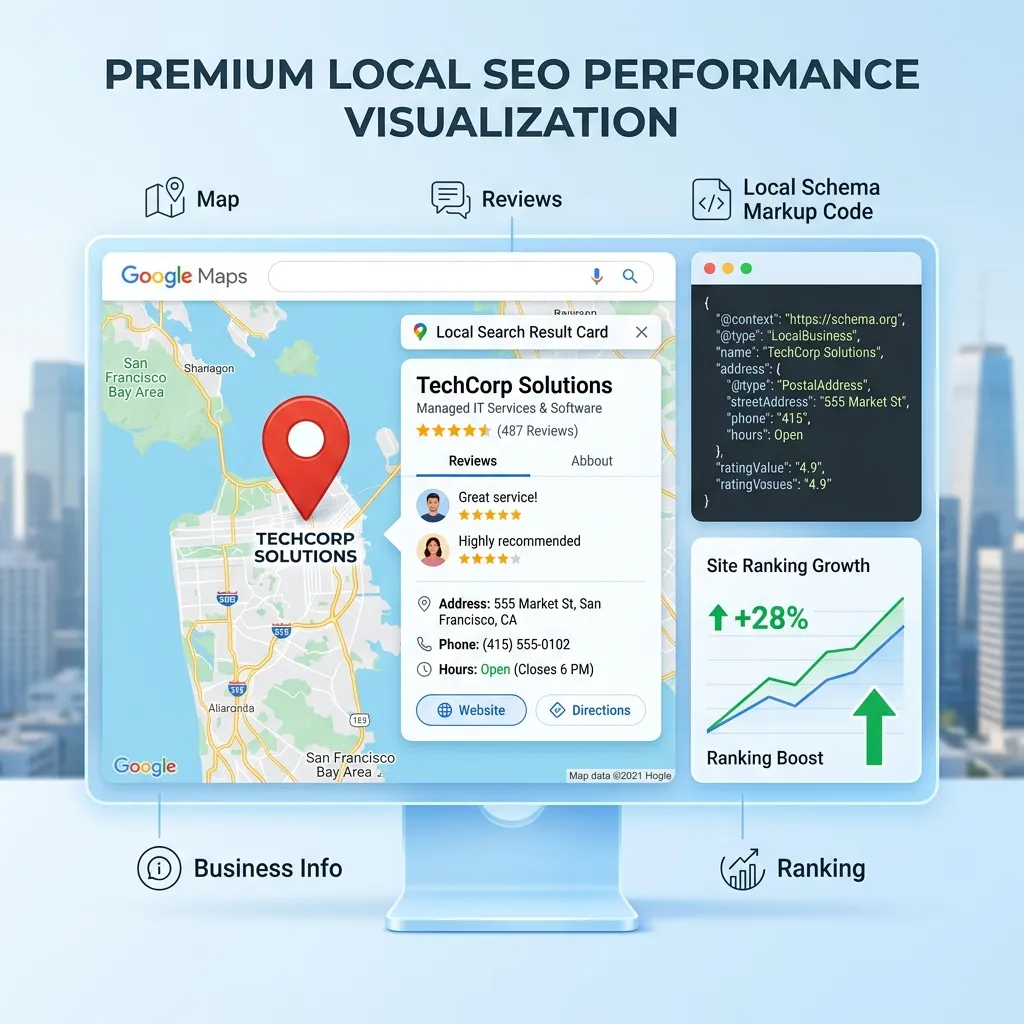
Google Business Profile Optimization Guide 2026: Complete Local SEO Strategy
Learn how to optimize your Google Business Profile for local search rankings in 2026. Complete guide covering verification, posts, reviews, photos, and advanced features for Indian businesses.
Schema Markup Guide for Beginners: SEO & Rich Results
Beginner-friendly guide to implementing schema markup — improve search visibility, enable rich snippets, and optimise for AI search engines like ChatGPT and Perplexity.
Get Professional AEO / GEO Services
Achieve 48% AI share of voice — optimise content for Google AI Overviews, ChatGPT, Perplexity, and Claude.
