Why Your Business Needs AEO in 2026: Complete Guide to Answer Engine Optimization
Discover why Answer Engine Optimization (AEO) is essential for business visibility in 2026. Learn how to get cited by ChatGPT, Perplexity, and Google AI Overviews with actionable strategies.

The AI Search Revolution Is Already Here
In 2024, Google launched AI Overviews in the US. By mid-2026, AI-generated answers appear in over 60% of Google searches globally. ChatGPT processes more than 10 billion queries per month. Perplexity has become a primary research tool for millions of professionals. Claude, Gemini, and Copilot are reshaping how people access information.
The shift from clicking links to reading AI-generated answers is not coming — it is already here.
For businesses, this represents the most significant change in online discovery since Google itself. When a potential customer asks ChatGPT “Which is the best IT company in Haryana?” or queries Perplexity with “What are the top SEO strategies for 2026?”, the AI does not show a list of ten blue links. It synthesises an answer from across the web, citing 3-5 sources. If your business is not one of those sources, you do not just rank lower — you are invisible.
This guide explains why Answer Engine Optimization (AEO) is now a business-critical investment, how it works, and exactly what you need to do to make your business visible in the AI-powered search landscape of 2026.
The Business Case for AEO: Why Visibility Has Changed
The Zero-Click Reality
In 2025, Google reported that over 60% of searches now end without a click. Users get their answer directly from the search results page — through featured snippets, knowledge panels, and increasingly, AI Overviews. This trend is accelerating. By 2026, the majority of information-seeking queries are satisfied without users ever visiting a website.
This creates a fundamental problem for traditional SEO: if users never click, traffic drops regardless of ranking position.
AEO addresses this by shifting the goal from getting clicks to getting cited. A citation in an AI-generated answer still delivers value — brand awareness, authority perception, and in many cases, referral traffic from the citation link. A study by BrightEdge in early 2026 found that brands cited in AI Overviews saw an average of 23% increase in branded search volume within 30 days of being cited. Users who see a brand cited by an AI assistant are significantly more likely to search for that brand directly or visit its website later.
AI Search Growth Statistics
| Metric | 2024 | 2026 | Source |
|---|---|---|---|
| Google searches showing AI Overviews | ~15% | 60%+ | Google Search Status Dashboard |
| ChatGPT monthly active users | 180M | 500M+ | OpenAI Reports |
| Perplexity monthly queries | 10M | 1B+ | Perplexity Blog |
| Indian AI tool users | ~80M | 200M+ | NASSCOM |
| Enterprise AI adoption in India | 38% | 72% | Deloitte India Survey |
| Users who trust AI answers “a lot” | 34% | 58% | Pew Research Center |
The trajectory is clear. AI-powered search is not a niche channel — it is becoming the default way people find information online. Businesses that invest in AEO today gain a significant competitive advantage over those that wait.
The Citation Advantage
When an AI assistant cites your content, several things happen:
- Authority transfer — Users perceive your brand as an authoritative source, because an AI assistant selected your content over alternatives
- Brand recall — Even without a click, users remember your brand name from the citation. This drives future direct searches
- Trust building — Citing sources makes AI answers more credible, and your brand benefits from that association
- Referral traffic — When users want more detail, they click the citation link. Perplexity, in particular, drives significant referral traffic through inline citations
- Competitive moat — Early AEO adopters in any space create content that AI engines have already learned to cite, making it harder for latecomers to displace them
How AI Answer Engines Select Content
To optimize for AEO, you need to understand how AI engines evaluate and select sources. While each platform has unique characteristics, they share common evaluation criteria.
Common Selection Factors
Factual accuracy and specificity. AI engines cross-reference claims across multiple sources. Content that makes specific, verifiable claims with supporting data is far more likely to be cited than vague or generic content. If your content says “SEO is important for businesses,” that is too generic. If it says “Businesses that invest in SEO see an average of 14.6% conversion rate compared to 1.7% for outbound methods,” that is specific, citable, and verifiable.
Content structure and machine readability. AI engines parse HTML structure to understand content hierarchy. Well-structured content with clear H2 and H3 headings, bullet points, short paragraphs, and direct answer blocks is significantly easier for AI engines to extract and cite. Content buried in unstructured paragraphs or complex layouts is less likely to be selected.
Source diversity and authority signals. Content that references multiple authoritative sources — government data, industry reports, peer-reviewed studies, recognized experts — is more likely to be cited. AI engines look for content that demonstrates breadth of research and depth of understanding.
Structured data implementation. Schema markup (JSON-LD) provides explicit signals about what your content means. FAQPage schema tells AI engines that specific blocks contain question-answer pairs. HowTo schema marks step-by-step instructions. Article schema signals author, publication date, and publisher. Content with proper structured data is consistently cited more frequently than identical content without it.
Content freshness and maintenance. AI engines deprioritize outdated content. Pages with recent publication dates, regular updates, and maintained statistics are preferred over content that has not been touched in years. The “last updated” field in Article schema is a direct signal AI engines use for freshness evaluation.
Platform-Specific Behaviors
Google AI Overviews prioritize content from sites with strong E-E-A-T signals — domain authority, author expertise, content accuracy, and user engagement metrics. Google’s ecosystem data gives it the most sophisticated source evaluation of any AI platform. Sites with established Google Search presence, strong backlink profiles, and good Core Web Vitals scores have a significant advantage.
ChatGPT Search (powered by Bing) favors concise, factual content with clear attribution. It prefers content that directly answers questions in 40-100 words, with specific data points and named sources. ChatGPT citations heavily weight content structure — FAQ pages, listicles, and comparison tables are overrepresented in its citations compared to narrative-style content.
Perplexity is built for attribution and citation diversity. It explicitly names sources in its answers and often cites 3-5 sources per query. Perplexity favors authoritative content with strong domain expertise signals and tends to cite original research, case studies, and expert commentary over generic informational content.
Claude (when web-enabled) favors thorough, well-reasoned content with logical structure and depth. Unlike other platforms that prefer concise answers, Claude often selects longer, more comprehensive passages that demonstrate thorough treatment of a topic. Content that presents balanced perspectives with supporting evidence performs well in Claude citations.
The Cost of Ignoring AEO
Businesses that delay AEO investment face several concrete risks.
Risk 1: Traffic Decline from Traditional Channels
As AI Overviews capture more search real estate, traditional organic click-through rates continue to decline. If your SEO strategy focuses exclusively on ranking in blue links, you are optimizing for a shrinking portion of the search results page. Industry data from early 2026 shows that even #1-ranked organic results in Google are seeing 15-30% fewer clicks compared to 2023, with the decline concentrated in informational queries — exactly the type of query that AEO targets.
Risk 2: Competitors Capture AI Mindshare
The brands that get cited by AI engines today establish citation patterns that persist. Once an AI engine has learned to cite a particular source for a specific query type, it tends to continue citing that source. Early AEO adopters build a competitive moat that latecomers find difficult to overcome. In emerging categories like AI-powered business services, local service discovery, and technology consulting, the brands that establish AI citation presence in 2026 will have a lasting advantage.
Risk 3: Missed Brand Authority Signals
Being cited by AI engines is itself an authority signal. Google and other search engines increasingly use AI citation data as a quality signal. Brands that appear in AI Overviews, ChatGPT answers, and Perplexity citations accumulate authority that benefits their entire digital presence. Conversely, brands that never appear in AI answers miss out on this compounding authority effect.
Risk 4: Younger Audiences Become Unreachable
Gen Z and younger Millennials increasingly use AI assistants as their primary information discovery tools. Over 40% of 18-34 year-olds in India report using ChatGPT or similar AI tools for product research, service discovery, and business evaluation. If your brand is not cited by AI engines, you are effectively invisible to the fastest-growing demographic of decision-makers.
AEO Strategies That Deliver Results in 2026
1. Create Direct-Answer Content Architecture
The foundation of AEO is content that directly answers specific questions. This requires a shift from keyword-focused content planning to question-focused content planning.
Start by mapping every question your customers ask throughout their buying journey. Use tools like AlsoAsked, AnswerThePublic, and Google’s People Also Ask to discover real queries. Group them by topic, priority, and buying stage.
For each question, create a dedicated content block with:
- A clear question as the heading (H3)
- A direct, factual answer in 40-80 words
- Supporting data, statistics, or examples
- A link to more detailed content
This direct-answer format maps directly to how AI engines extract and cite content. A well-structured FAQ page with 10-15 question-answer pairs is one of the highest-value AEO assets you can create.
2. Implement Comprehensive Structured Data
Schema markup is the most direct communication channel between your content and AI engines. For AEO in 2026, these schema types are essential:
- FAQPage — For any question-answer content. This is the single most impactful schema type for AEO
- HowTo — For step-by-step guides and processes
- Article — For blog posts and news content. Include headline, author, datePublished, dateModified, and publisher
- Organization — For business information. Include name, logo, URL, and social profiles
- Person — For author expertise signals. Include credentials, affiliations, and professional links
- LocalBusiness — Essential for businesses serving specific geographic areas
- Speakable — A relatively new schema type that marks content suitable for text-to-speech and AI voice answers
Implement schema markup in JSON-LD format (preferred over microdata) and validate all structured data using Google’s Rich Results Test and Schema.org validator before publishing.
3. Build Topic Authority Through Content Clusters
AI engines evaluate topical authority — how comprehensively your site covers a subject area. A single page on a topic is far less likely to be cited than a comprehensive content cluster with 10-20 interconnected pages covering different aspects of the same topic.
Build content clusters by:
- Identifying a core topic relevant to your business
- Creating a pillar page that provides a comprehensive overview
- Publishing 10-20 cluster pages that cover specific subtopics, questions, and use cases
- Interlinking all cluster pages to the pillar page and to each other
- Updating content regularly to maintain freshness signals
For a digital services company like DigiHaryana, a content cluster around “Digital Transformation for Haryana Businesses” might include pillar content on the overall strategy, with cluster pages covering specific aspects like website development, SEO, AEO, cloud migration, cybersecurity, and digital marketing — each optimized for direct answers and AI citation.
4. Optimize for Entity Recognition
AI engines build knowledge graphs that map entities (businesses, people, places, concepts) and their relationships. Strong entity signals increase the likelihood of citation.
Optimize entity recognition by:
- Maintaining consistent business information across all platforms (NAP consistency)
- Creating and optimizing Wikipedia and Wikidata entries where appropriate
- Building profiles on authoritative platforms (LinkedIn, Crunchbase, Glassdoor)
- Earning mentions on news sites, industry publications, and blogs
- Using consistent brand terminology across all content
- Linking to and from authoritative sources in your industry
For local businesses, entity optimization means ensuring your Google Business Profile is complete, verified, and regularly updated — Google’s local entity graph feeds directly into AI Overviews for location-based queries.
5. Publish Authoritative Research and Data
Original research and proprietary data are among the most citable content types. AI engines heavily weight content that presents unique data, original analysis, or proprietary research.
Publish original research relevant to your industry: surveys, market analyses, trend reports, case study compilations. Data-driven content like “State of Digital Marketing in India 2026” or “Haryana Business Technology Adoption Survey” creates citable assets that AI engines reference repeatedly.
Even if original research is not feasible, citing diverse authoritative sources in your content significantly improves citation probability. Reference government data, industry reports from recognized organizations, academic research, and expert commentary. Content that synthesizes multiple authoritative sources demonstrates the depth that AI engines reward.
6. Optimize Content Freshness
AI engines are highly sensitive to content freshness. Outdated statistics, expired offers, and old publication dates reduce citation probability.
Maintain content freshness by:
- Adding “last updated” dates to all content pages
- Reviewing and updating key content quarterly
- Refreshing statistics and data points with current information
- Adding new sections, examples, and case studies to existing content
- Republishing updated content with visible change notes
Content freshness is particularly important for rapidly evolving topics like AI search, digital marketing, and technology trends — exactly the topics where AEO is most impactful.
AEO Across Business Types
Digital Agencies and Service Providers
For agencies offering digital services, AEO directly impacts lead generation. When potential clients ask “Which is the best SEO company in India?” or “How much does digital marketing cost?”, AI engines synthesize answers from agency websites. Agencies optimized for AEO capture leads at the exact moment of purchase intent. Specific strategies include publishing detailed service pages with pricing information, client case studies with measurable results, and FAQ sections addressing common client questions.
E-commerce and Retail
Product discovery through AI search is growing rapidly. When users ask “What are the best wireless earbuds under ₹5,000?” or “Which laptop is best for programming?”, AI engines cite product pages, review content, and comparison guides. E-commerce businesses should optimize product pages with structured data (Product, Review, Offer), publish comparison guides and buying guides, and maintain fresh, detailed product descriptions with specific specifications and use cases.
Local Service Businesses
Local discovery through AI search is a massive opportunity. When users ask “Best restaurant in Hisar” or “Top web developer near me”, AI engines synthesize local content. AEO for local businesses means optimizing Google Business Profiles with complete information and regular posts, creating location-specific FAQ pages that answer common customer questions, earning local citations from directories and review platforms, and publishing local content that demonstrates community involvement and local expertise.
SaaS and Technology Companies
B2B technology buying decisions are increasingly influenced by AI research. When a CTO asks “Best project management tool for small teams” or “How to choose a cloud provider”, AI engines evaluate and cite software review content, comparison pages, and documentation. AEO for SaaS companies involves creating comprehensive documentation and knowledge bases, publishing feature comparisons and competitor analyses, maintaining up-to-date pricing and plan information, and building detailed help centers that answer specific use case questions.
Measuring AEO Success
Key Performance Indicators
Citation frequency. How often does your content appear as a cited source in AI-generated answers? Track this monthly for your top 20-30 target queries.
Brand mention rate. How often is your brand name mentioned in AI responses, even without a direct citation link? This measures brand awareness impact.
AI Overview appearances. Use Google Search Console to track when your content appears in Google AI Overviews. Monitor the “Search Appearance” report for “AI Overview” specifically.
Referral traffic from AI platforms. Track traffic from perplexity.ai, chatgpt.com, and other AI platforms in your analytics. This traffic tends to have high engagement rates because users arrive from a trusted recommendation.
Structured data performance. Monitor schema markup validation scores and Google’s Rich Results report to ensure your structured data is error-free and eligible for rich results.
Branded search volume. Track branded search volume before and after AEO implementation. Brands cited by AI engines consistently see branded search growth.
Tools for AEO Measurement
- Google Search Console — AI Overview impressions, structured data reports, query performance
- Perplexity — Manual query testing with citation tracking
- ChatGPT — Manual query testing across different models (GPT-4o, GPT-4.1)
- Otterly AI — Automated AI brand mention tracking across platforms
- Peec AI — AI search visibility monitoring and competitive analysis
- Brand24, Mention — General brand mention monitoring that captures AI citations
- Schema.org Validator — Structured data validation
- Google Rich Results Test — Schema markup testing
Getting Started with AEO: A 30-Day Action Plan
Week 1: Audit and Question Mapping
Audit your existing content for AEO readiness. Check for structured data implementation, direct-answer formatting, content freshness, and authority signals. Map 20-30 high-priority questions your customers ask, using tools like AlsoAsked and AnswerThePublic. Identify quick wins — content that already addresses key questions but needs formatting or schema improvements.
Week 2: Schema Implementation and Quick Fixes
Implement or fix structured data on your highest-priority pages. Start with FAQPage schema on your service pages and blog posts. Add Organization and Person schema for your business and authors. Fix any structured data errors identified in your audit.
Week 3: Direct-Answer Content Creation
Create direct-answer content blocks for your mapped questions. For each question, write a 40-80 word direct answer that can be extracted and cited independently. Add these answer blocks to existing content or create new FAQ-style pages.
Week 4: Authority Building and Monitoring
Start earning citations and brand mentions through guest posting, directory submissions, and partnership content. Set up monitoring for AI brand mentions using available tools. Document your baseline citation frequency for target queries. Schedule monthly reviews to track progress and identify new opportunities.
Conclusion: The Time to Invest in AEO Is Now
The shift from traditional search to AI-powered answer engines is accelerating faster than any previous change in digital marketing. Google’s AI Overviews, ChatGPT Search, Perplexity, Claude, and Gemini are not experiments — they are the future of how people discover information, evaluate options, and make decisions.
Businesses that invest in AEO today gain three compounding advantages:
- Immediate visibility in the fastest-growing search channel
- Competitive moat as AI citation patterns solidify around early adopters
- Authority accumulation as citations beget more citations and stronger domain authority
The businesses that wait will find themselves competing for a shrinking pool of traditional search clicks while their AEO-optimized competitors capture the growing AI citation channel.
Ready to make your business visible in AI search? DigiHaryana specializes in Answer Engine Optimization for Indian businesses. Our AEO methodology combines structured data implementation, direct-answer content architecture, authority building, and ongoing monitoring to ensure your brand gets cited by the AI engines shaping the future of search.
Use our free AI Visibility Checker to assess your current AI search readiness and discover exactly where your content stands in the AI citation landscape.
Related Articles
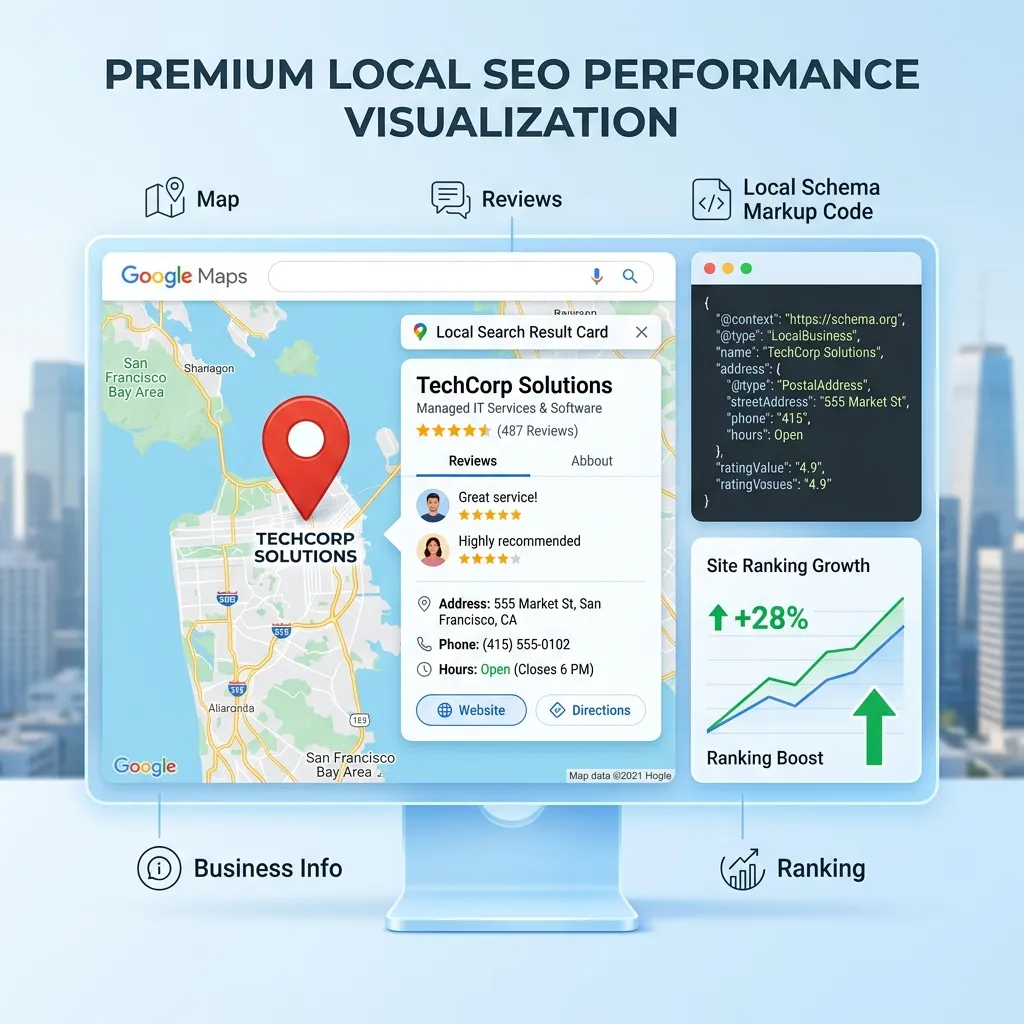
Google Business Profile Optimization Guide 2026: Complete Local SEO Strategy
Learn how to optimize your Google Business Profile for local search rankings in 2026. Complete guide covering verification, posts, reviews, photos, and advanced features for Indian businesses.

Voice Search Optimization for Business: Complete Guide 2026
Learn how to optimize your website and content for voice search — covering natural language queries, featured snippets, schema markup, and local search strategies for AI-powered assistants.
Schema Markup Guide for Beginners: SEO & Rich Results
Beginner-friendly guide to implementing schema markup — improve search visibility, enable rich snippets, and optimise for AI search engines like ChatGPT and Perplexity.
Get Professional AEO / GEO Services
Achieve 48% AI share of voice — optimise content for Google AI Overviews, ChatGPT, Perplexity, and Claude.
