
Schema Markup Guide for Beginners: SEO & Rich Results
Beginner-friendly guide to implementing schema markup — improve search visibility, enable rich snippets, and optimise for AI search engines like ChatGPT and Perplexity.

Quick answer: Schema markup is structured data added to your website’s HTML that helps search engines understand your content’s meaning and context. Implemented as JSON-LD code, schema types like Article, FAQPage, LocalBusiness, and Product can unlock rich snippets in search results and increase your chances of being cited in Google AI Overviews. According to Google, pages with schema markup earn up to 30% more clicks through rich results.
Every business owner, blogger, and developer wants their website to appear higher in search results. But most people focus only on keywords and backlinks while ignoring one of the most powerful technical SEO levers available — schema markup. Schema markup is a type of structured data that you add to your website’s HTML. It gives search engines explicit information about your content instead of forcing them to guess. When you tell Google exactly what a piece of content means, not just what it says, you unlock rich snippets, better rankings, and visibility in AI-powered search features like Google’s AI Overviews and Perplexity. This guide walks you through everything you need to know about schema markup as a beginner — what it is, why it matters, how to implement it, and how to avoid common mistakes.
What is Schema Markup?
Schema markup is a standardized vocabulary of tags that you add to your website’s HTML to help search engines understand the meaning behind your content. Think of it as labeling the furniture in a room so that someone walking in for the first time immediately knows what each item is. Without labels, they have to look at a chair and figure out on their own that it is a chair. With labels, the answer is instant and certain.
Schema markup works on the same principle. When Google crawls a page without schema, it analyzes the text and makes educated guesses. It sees “₹1,499” and assumes it might be a price. It sees “4.5 stars” and assumes it might be a rating. But when you add schema markup, you explicitly tell Google: “This is a product price. This is a review rating. This is a recipe name.”
Schema markup is built on schema.org, a collaborative vocabulary created by Google, Microsoft, Yahoo, and Yandex. It supports hundreds of content types — from articles and products to local businesses, events, FAQs, how-to guides, and more. The recommended format is JSON-LD (JavaScript Object Notation for Linked Data), which Google explicitly prefers over microdata and RDFa because it is easier to implement and maintain.
You do not need to be a developer to understand schema markup. At its core, it is just structured information about your content written in a format search engines can read quickly and accurately.
Why Schema Matters for SEO
Schema markup is no longer optional for businesses that want to compete in search. Here are the key reasons it matters:
Rich snippets and enhanced search results. Schema markup enables rich results — visually enhanced search listings that include star ratings, prices, FAQ dropdowns, recipe images, event dates, and more. These rich snippets take up more screen space, look more professional, and significantly increase click-through rates. Studies show that pages with rich results earn up to 30% more clicks than standard listings.
AI visibility and answer engine optimization. AI-powered search engines like Google’s AI Overviews, Perplexity, ChatGPT search, and Bing Chat rely heavily on structured data to understand and cite content. Schema markup makes it dramatically easier for AI systems to identify question-answer pairs, extract factual data, and attribute information to your site. In the age of AEO (Answer Engine Optimization), schema is your bridge to getting cited by AI.
Better rankings. While schema markup is not a direct ranking factor, the improved click-through rates, lower bounce rates, and higher engagement signals it generates indirectly boost your rankings. Google also uses schema to better understand topical relevance, which helps with semantic search.
Knowledge panel eligibility. Organization and person schema help Google build knowledge panels — the information boxes that appear on the right side of search results. These panels establish authority and trust at a glance.
Future-proofing. Search is evolving toward structured, machine-readable data. Implementing schema now positions your website for emerging features and search experiences that will increasingly reward structured content.
Types of Schema Markup
Different types of schema markup serve different purposes. Here are the most important ones for businesses:
Organization schema provides Google with your business name, logo, website URL, contact information, and social media profiles. It is the foundation of your brand’s structured identity online. Every business website should implement this.
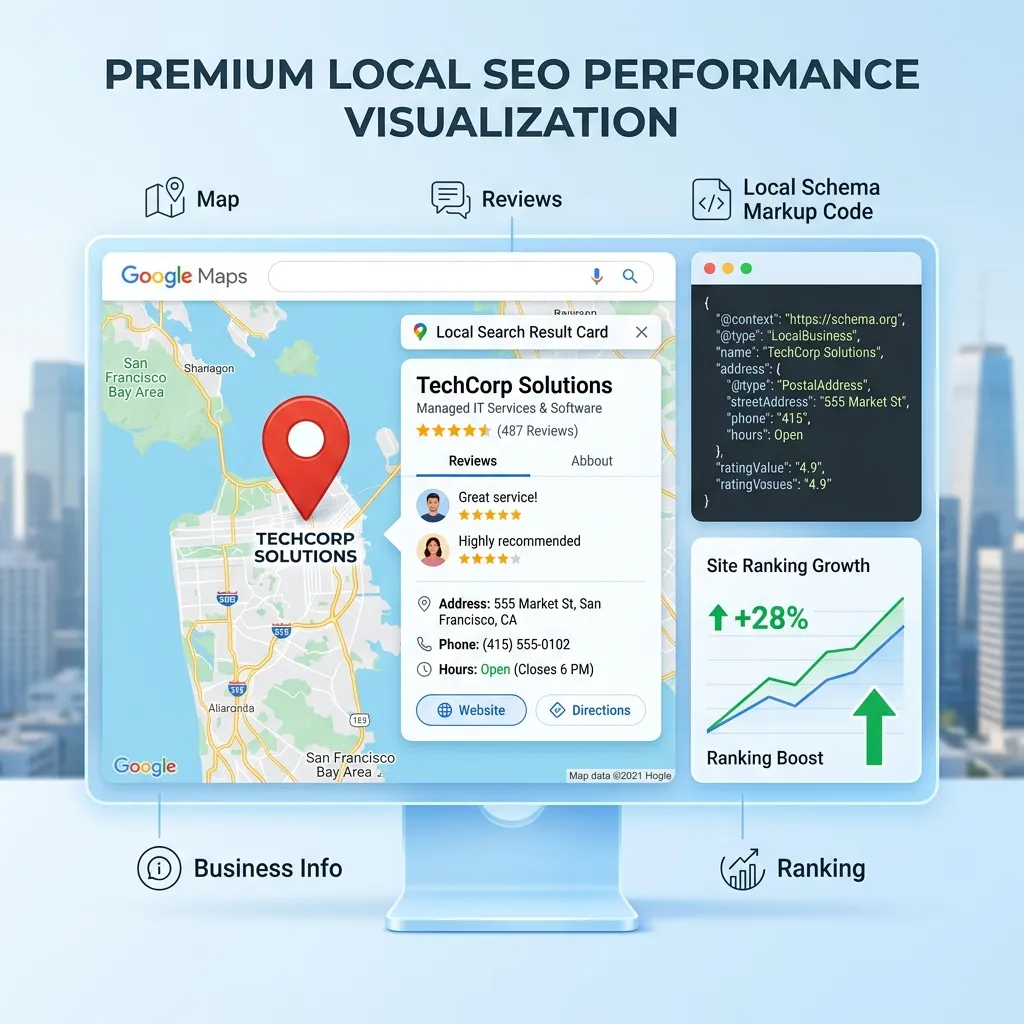
LocalBusiness schema extends Organization schema with location-specific details — your physical address, phone number, opening hours, service area, and geo-coordinates. This is essential for local SEO, especially if you serve customers in a specific city or region like Haryana.
FAQ schema marks up frequently asked questions and their answers on a page. It creates expandable FAQ sections directly in search results, which improves visibility and saves users a click. FAQ schema works well on service pages, product pages, and support documentation.
HowTo schema structures step-by-step instructional content. It can display rich results with numbered steps and images, making your how-to content visually appealing in search.
Product schema adds structured data about products — price, availability, condition, brand, images, and SKU. It is critical for e-commerce websites that want their products to display with price tags and “In Stock” labels directly in search results.
Review and AggregateRating schema surfaces star ratings in search snippets. A product or service page with visible stars in search results is far more likely to get clicks than one without.
BreadcrumbList schema creates breadcrumb trails in search results, showing users where a page sits in your site hierarchy. It improves both user experience and crawlability.
Article schema marks up blog posts and news articles with headline, author name, publish date, modified date, and featured image. It is required for eligibility in Google News and helps with general content understanding.
How to Add Schema Markup with JSON-LD
JSON-LD is the format Google recommends for structured data. You place a <script type="application/ld+json"> block in the <head> or <body> of your page. Here is a basic Organization schema example:
{
  "@context": "https://schema.org",
  "@type": "Organization",
  "name": "DigiHaryana",
  "url": "https://digi-haryana.com",
  "logo": "https://digi-haryana.com/logo.png",
  "contactPoint": {
    "@type": "ContactPoint",
    "telephone": "+91-9876543210",
    "contactType": "customer service"
  },
  "sameAs": [
    "https://www.facebook.com/digiharyana",
    "https://www.instagram.com/digiharyana",
    "https://www.linkedin.com/company/digiharyana"
  ]
}
You can add this directly to your HTML like this:
<script type="application/ld+json">
{
  "@context": "https://schema.org",
  "@type": "Organization",
  "name": "DigiHaryana",
  "url": "https://digi-haryana.com",
  "logo": "https://digi-haryana.com/logo.png"
}
</script>
For WordPress users, plugins like Yoast SEO, RankMath, and Schema Pro handle JSON-LD generation automatically. For custom-built websites, you can generate schema programmatically using your CMS data or add it manually page by page.
Always validate your schema before publishing using Google’s Rich Results Test tool.
FAQ Schema: Step-by-Step Example
FAQ schema is one of the easiest and most impactful types to implement. Here is a complete, ready-to-use example for a page with three frequently asked questions:
{
  "@context": "https://schema.org",
  "@type": "FAQPage",
  "mainEntity": [
    {
      "@type": "Question",
      "name": "What is schema markup?",
      "acceptedAnswer": {
        "@type": "Answer",
        "text": "Schema markup is structured data vocabulary added to your website's HTML that helps search engines understand your content more accurately. It enables rich snippets like star ratings, FAQs, and product details in search results."
      }
    },
    {
      "@type": "Question",
      "name": "Does schema markup improve SEO rankings?",
      "acceptedAnswer": {
        "@type": "Answer",
        "text": "Schema markup is not a direct ranking factor, but it improves click-through rates through rich snippets, enhances AI visibility, and sends better engagement signals to search engines, all of which indirectly improve rankings."
      }
    },
    {
      "@type": "Question",
      "name": "What format of schema does Google recommend?",
      "acceptedAnswer": {
        "@type": "Answer",
        "text": "Google recommends JSON-LD (JavaScript Object Notation for Linked Data) as the preferred format for implementing schema markup on your pages."
      }
    }
  ]
}
Place this in a <script type="application/ld+json"> tag in your page’s HTML. The questions and answers should reflect the actual FAQ content visible on the page. Google requires that the marked-up content matches what users see on the page.
LocalBusiness Schema for Indian Businesses
If you operate a business with a physical location in India, LocalBusiness schema is essential for local SEO. Here is a complete example:
{
  "@context": "https://schema.org",
  "@type": "LocalBusiness",
  "name": "DigiHaryana Digital Marketing Agency",
  "image": "https://digi-haryana.com/office.jpg",
  "url": "https://digi-haryana.com",
  "telephone": "+91-9876543210",
  "priceRange": "$$",
  "address": {
    "@type": "PostalAddress",
    "streetAddress": "Sector 14, Near City Mall",
    "addressLocality": "Gurugram",
    "addressRegion": "Haryana",
    "postalCode": "122001",
    "addressCountry": "IN"
  },
  "geo": {
    "@type": "GeoCoordinates",
    "latitude": 28.4595,
    "longitude": 77.0266
  },
  "openingHoursSpecification": [
    {
      "@type": "OpeningHoursSpecification",
      "dayOfWeek": ["Monday", "Tuesday", "Wednesday", "Thursday", "Friday"],
      "opens": "09:00",
      "closes": "18:00"
    },
    {
      "@type": "OpeningHoursSpecification",
      "dayOfWeek": "Saturday",
      "opens": "10:00",
      "closes": "14:00"
    }
  ],
  "sameAs": [
    "https://www.facebook.com/digiharyana",
    "https://www.instagram.com/digiharyana"
  ]
}
Key things to include: your complete Indian address with PIN code, Google Maps geo-coordinates, accurate opening hours for each day, and a link to your Google Business Profile. This schema helps your business appear in Google Maps results, local packs, and “near me” searches.
Product and Review Schema for E-Commerce
E-commerce websites benefit enormously from Product schema. Here is an example that includes price, availability, and aggregate reviews:
{
  "@context": "https://schema.org",
  "@type": "Product",
  "name": "Wireless Bluetooth Headphones",
  "image": "https://example.com/images/headphones.jpg",
  "description": "Premium wireless headphones with active noise cancellation and 30-hour battery life.",
  "brand": {
    "@type": "Brand",
    "name": "AudioTech"
  },
  "sku": "AT-WH-1000",
  "offers": {
    "@type": "Offer",
    "url": "https://example.com/products/wireless-headphones",
    "priceCurrency": "INR",
    "price": "2499",
    "availability": "https://schema.org/InStock",
    "seller": {
      "@type": "Organization",
      "name": "DigiHaryana Store"
    }
  },
  "aggregateRating": {
    "@type": "AggregateRating",
    "ratingValue": "4.5",
    "reviewCount": "238"
  }
}
This markup tells Google exactly what your product costs, whether it is in stock, and what customers think of it. The result is a search listing that displays the price, stock status, and star rating — all of which dramatically increase click-through rates for product pages.
You can also add individual Review schema entries for specific customer reviews to provide even more structured data to search engines.
Testing Your Schema
Never publish schema markup without testing it first. Here are the tools you should use:
Google Rich Results Test (search.google.com/test/rich-results) is the primary tool for validating your schema. It checks whether your markup is eligible for rich results and highlights errors and warnings. It also shows you a preview of how your page might appear in search results with rich snippets.
Schema.org Validator (validator.schema.org) validates your markup against the official schema.org vocabulary. It catches structural errors and type mismatches that the Google tool might miss.
Google Search Console Enhancements Report monitors your schema implementation at scale. After validation, submit your updated pages for re-indexing through Search Console. Check the Enhancements section regularly to catch new errors as they arise.
Run validation every time you modify schema, update pages, or migrate your site. Schema errors can silently prevent rich results from appearing.
Schema for AI Search and Answer Engines (AEO)
AI-powered search is reshaping how users find information. Tools like Google AI Overviews, Perplexity, ChatGPT search, and Bing Chat do not just rank pages — they synthesize answers from multiple sources. Schema markup plays a critical role in getting your content cited by these systems.
FAQ schema explicitly structures question-answer pairs that AI can extract directly. Article schema provides clear signals about authorship, publication date, and topic. HowTo schema breaks content into numbered steps that AI can present as instructions. Product schema gives AI the factual data it needs to make recommendations.
Implementing comprehensive schema is one of the highest-ROI investments for AEO. It is the difference between your content being invisible to AI and being the source it cites.
Common Schema Mistakes to Avoid
Marking up content that does not exist on the page. Google requires that your schema matches visible page content. If your schema says you have five reviews but the page shows two, you are violating guidelines.
Using the wrong schema type. Do not use Product schema for a blog post or FAQPage schema for content that is not structured as questions and answers.
Ignoring validation errors. Warnings may not block rich results, but errors will. Always fix errors before publishing.
Adding spammy or misleading markup. Fake ratings, hidden prices, or markup for content unrelated to the page can result in manual actions — penalties that remove your rich results entirely.
Forgetting to update schema. If your business hours, prices, or contact details change, update your schema. Stale structured data creates inconsistencies that harm trust with search engines.
Not nesting schemas correctly. Complex pages may need multiple schema types. Use proper nesting rather than creating separate disconnected blocks.
Schema Checklist by Page Type
Not every page needs every type of schema. Here is a practical breakdown:
- Homepage: Organization schema, BreadcrumbList schema
- About page: Organization or Person schema, BreadcrumbList schema
- Blog posts: Article schema, BreadcrumbList schema
- Product pages: Product schema, AggregateRating schema, BreadcrumbList schema
- Service pages: Service schema, FAQ schema, BreadcrumbList schema
- Contact page: LocalBusiness schema, ContactPoint schema, BreadcrumbList schema
- Location pages: LocalBusiness schema, GeoCoordinates schema, BreadcrumbList schema
- How-to content: HowTo schema, BreadcrumbList schema
- FAQ pages: FAQPage schema, BreadcrumbList schema
BreadcrumbList schema is a good default for almost every page type. Start with the schemas that match your highest-priority pages, validate thoroughly, and expand your implementation over time.
Conclusion
Schema markup is no longer a technical nice-to-have. It is a foundational element of modern SEO and AI search visibility. It helps search engines understand your content with precision, enables rich results that drive more clicks, and positions your website to be cited by AI answer engines.
Start simple. Implement Organization schema on your homepage, Article schema on your blog posts, and LocalBusiness schema if you serve a local audience. Test everything with Google’s Rich Results Test, monitor your Search Console, and expand your schema as your content grows. If you want help implementing schema markup on your website, contact DigiHaryana — we handle structured data implementation for businesses across Haryana and beyond.
Frequently Asked Questions
Q1: Is schema markup a ranking factor for Google? A1: Schema markup is not a direct ranking factor according to Google, but it enables rich results (star ratings, prices, FAQs) that improve click-through rates. Pages with proper schema are also more likely to be cited in Google AI Overviews because structured data helps AI systems understand content.
Q2: Do I need coding skills to implement schema markup? A2: Basic schema implementation requires adding JSON-LD code to your website’s HTML or using a plugin (Yoast SEO, Rank Math for WordPress). For custom implementations, familiarity with HTML and JSON is helpful but not required — Google’s Structured Data Markup Helper can generate the code for you.
Q3: What is the most important schema type to start with? A3: Start with Organization schema on your homepage (includes business name, logo, contact info), Article schema on your blog posts, and LocalBusiness schema if you serve a local area. These three cover the majority of search visibility use cases.
Q4: Can schema markup hurt my rankings? A4: Incorrect or spammy schema markup can trigger Google’s structured data manual action, which removes your rich results. Always validate your schema using Google’s Rich Results Test before publishing. Follow schema.org guidelines and never markup content that isn’t visible to users.
Q5: How often should I update my schema markup? A5: Update schema when your business information changes (address, phone, hours), when you publish new content types (FAQs, how-to guides, products), or when Google announces new rich result types. Quarterly audits of your structured data implementation are recommended.
Need expert help? Learn how our SEO services can help you achieve better results.
Advanced SEO & AEO Technical Framework
To successfully rank in AI overviews and traditional search engines alike, a structured, programmatic approach is required. Use this framework to design and audit your content.
JSON-LD Structured Data Template
Deploying proper schema markup is the single most effective way to help search engines parse your entity relationships. Here is a standard FAQ and Article schema template:
{
  "@context": "https://schema.org",
  "@graph": [
    {
      "@type": "TechArticle",
      "headline": "Schema Markup Guide for Beginners",
      "description": "A beginner-friendly guide to implementing schema markup for better search visibility, rich snippets, and AI search engine optimization.",
      "author": {
        "@type": "Person",
        "name": "Simran",
        "url": "https://www.digiharyana.com/authors/simran/"
      },
      "publisher": {
        "@type": "Organization",
        "name": "DigiHaryana"
      },
      "datePublished": "2026-02-12",
      "dateModified": "2026-06-09"
    },
    {
      "@type": "FAQPage",
      "mainEntity": [
        {
          "@type": "Question",
          "name": "Is schema markup a ranking factor for Google?",
          "acceptedAnswer": {
            "@type": "Answer",
            "text": "Schema markup is not a direct ranking factor, but it enables rich results that improve click-through rates and AI Overview citation likelihood."
          }
        },
        {
          "@type": "Question",
          "name": "What is the most important schema type to start with?",
          "acceptedAnswer": {
            "@type": "Answer",
            "text": "Start with Organization schema on your homepage, Article schema on blog posts, and LocalBusiness schema for local service areas."
          }
        },
        {
          "@type": "Question",
          "name": "Can schema markup hurt my rankings?",
          "acceptedAnswer": {
            "@type": "Answer",
            "text": "Incorrect schema can trigger Google's structured data manual action. Always validate using Google's Rich Results Test before publishing."
          }
        }
      ]
    }
  ]
}
Actionable Optimization Checklist
- Direct Answer Block: Write a 45-word absolute summary at the beginning of each core section.
- Table of Contents: Enable sticky scroll links so answer engines can map anchor segments.
- Entity Association: Mention industry-standard terms and authoritative sources to strengthen entity hubs.
- Core Web Vitals Audit: Maintain LCP under 2.5s and CLS under 0.1 to secure search crawler prioritization.
Related Articles
Why Your Business Needs AEO in 2026: Complete Guide to Answer Engine Optimization
Discover why Answer Engine Optimization (AEO) is essential for business visibility in 2026. Learn how to get cited by ChatGPT, Perplexity, and Google AI Overviews with actionable strategies.
Google Business Profile Optimization Guide 2026: Complete Local SEO Strategy
Learn how to optimize your Google Business Profile for local search rankings in 2026. Complete guide covering verification, posts, reviews, photos, and advanced features for Indian businesses.

Voice Search Optimization for Business: Complete Guide 2026
Learn how to optimize your website and content for voice search — covering natural language queries, featured snippets, schema markup, and local search strategies for AI-powered assistants.
Get Professional SEO Services
Top-3 rankings and 3.4× organic traffic growth — technical SEO, content strategy, and white-hat link building.
