
What is AEO? Complete Guide for 2026
Learn what Answer Engine Optimization (AEO) is, how it differs from SEO, and how to optimise content for AI search engines like ChatGPT, Perplexity, and Google AI Overviews.

Quick answer: Answer Engine Optimization (AEO) is the practice of structuring content so AI-powered search engines like ChatGPT, Perplexity, and Google AI Overviews cite it as a source in generated answers. Unlike traditional SEO that targets clickable rankings, AEO optimizes for the citation layer — making your information extractable, authoritative, and machine-readable. In 2026, AEO is essential because AI Overviews appear in approximately 45% of Google searches.
The way people find information online is changing fast. AI-powered answer engines — ChatGPT, Perplexity, Google AI Overviews, and Claude — are reshaping how users interact with search results. Instead of clicking through a list of links, users now receive direct, synthesized answers pulled from multiple sources. If your content isn’t optimized for these systems, you risk becoming invisible.
Answer Engine Optimization (AEO) is the practice of structuring and optimizing your online content so that AI-powered answer engines select, cite, and surface your information when users ask questions. This guide covers everything you need to know about AEO in 2026, from foundational concepts to actionable steps.
What Is AEO? — A Clear Definition
Answer Engine Optimization is the process of making your content easily discoverable, understandable, and citable by AI systems that generate direct answers to user queries. Unlike traditional SEO, which targets ranking in search engine result pages (SERPs) with clickable links, AEO targets the citation layer — the specific passages and sources that AI models pull from when generating responses.
When someone asks ChatGPT, “What is AEO?” and it returns a concise definition sourced from your website, that’s AEO in action. The user may never click a link, but your brand receives the authority credit for being the cited source.
Practical examples of AEO success:
- Your blog post on “best CRM tools for small business” gets cited in Perplexity’s comparison answer
- Your product page’s structured data feeds into Google AI Overviews for purchase-related queries
- Your FAQ section provides the direct answer to a ChatGPT query about “how to register a GST number in India”
- Your expert quote appears in Claude’s response about digital marketing strategies
AEO is not a replacement for SEO — it’s an evolution. The businesses that thrive will be those that master both.
AEO vs Traditional SEO: Key Differences
Understanding where AEO diverges from traditional SEO is critical for building a strategy that covers both.
| Factor | Traditional SEO | Answer Engine Optimization (AEO) |
|---|---|---|
| Primary Goal | Rank in SERPs for clickable links | Get cited in AI-generated answers |
| Target Platform | Google, Bing search results | ChatGPT, Perplexity, Google AI Overviews, Claude |
| User Action | User clicks a link | User reads an inline answer |
| Content Format | Long-form, keyword-rich pages | Concise, well-structured, factual passages |
| Key Metric | Organic traffic, ranking position | Citation frequency, brand mentions in AI answers |
| Trust Signals | Backlinks, domain authority | Authority + structured data + factual accuracy + source diversity |
| Content Length | Longer content often ranks better | Optimal passages are 40-300 words, clearly scoped |
| Keyword Strategy | Exact match and semantic targeting | Question-based targeting, entity optimization |
| Technical SEO | Sitemap, robots.txt, page speed | All of the above + structured data (JSON-LD), semantic HTML |
| Competition | Competing with other web pages | Competing with other sources for AI citation |
The critical takeaway: SEO gets you ranked. AEO gets you cited. In 2026, you need both.
How AI Answer Engines Work
Understanding what happens behind the scenes helps you optimize strategically.
- ChatGPT retrieves information via Bing web search and its training data. It favors concise, factual, well-structured content and presents answers with source citations. Traditional Bing SEO signals still matter.
- Perplexity searches the web in real time and synthesizes multiple sources with inline citations. It’s built for attribution, favoring authoritative content with strong domain expertise signals.
- Google AI Overviews appear at the top of search results, synthesizing 3-5 web pages. Google heavily weights E-E-A-T signals — sites with strong domain authority, expertise, and structured data get priority.
- Claude favors thorough, well-reasoned content with clear logical structure and factual substance over marketing language.
Common thread: All engines prioritize content that directly answers questions, is structured for machine readability, comes from authoritative sources, and is factually accurate.
Step-by-Step: How to Optimize for AEO
Step 1: Map Your Audience’s Questions
Start by identifying the exact questions your target audience asks. Use tools like AnswerThePublic, AlsoAsked, and Google’s “People Also Ask” to discover real queries. Group questions by topic and priority. Focus on questions where you have genuine expertise or unique data to offer.
Example: If you run a digital marketing agency, your question map might include:
- “How much does digital marketing cost in India?”
- “What’s the difference between SEO and AEO?”
- “How do I choose a digital marketing agency?”
Step 2: Create Direct-Answer Content Blocks
For each high-priority question, write a 40-60 word direct answer at the top of a dedicated section. This “answer block” should be self-contained — it answers the question completely without requiring additional context. AI engines scan for this format and are more likely to extract and cite concise, complete answers.
Bad example: “Digital marketing pricing varies based on many factors including your business size, goals, and the agency you choose. There’s really no one-size-fits-all answer.” (Vague, no citation value.)
Good example: “In India, digital marketing services for small businesses typically cost ₹15,000 to ₹50,000 per month. Enterprise campaigns range from ₹1,00,000 to ₹5,00,000+ monthly. Pricing depends on services included: SEO, PPC, social media management, and content creation each carry separate costs.” (Factual, specific, citable.)
Step 3: Structure Content for Machine Readability
AI engines parse HTML structure to understand content hierarchy. Use:
- H2 and H3 headings that match question phrasing
- Bullet points and numbered lists for multi-part answers
- Short paragraphs (2-3 sentences for key points)
- Bold text for key terms and definitions
- Tables for comparisons and data-heavy content
Step 4: Implement Structured Data (Schema Markup)
Structured data tells AI engines exactly what your content is about. Key schema types for AEO:
- FAQPage — For question-and-answer content
- HowTo — For step-by-step guides
- Article — For news and blog content
- Organization — For business information
- Person — For author expertise signals
- LocalBusiness — For location-specific businesses
- Product — For product information and reviews
Step 5: Build Authority Signals
AI engines evaluate source credibility before citing content. Strengthen your authority by:
- Earning backlinks from reputable industry publications
- Publishing expert author bios with credentials and professional profile links
- Maintaining factual accuracy — AI engines cross-reference claims across multiple sources
- Keeping content current — outdated information is deprioritized
Step 6: Optimize for Entity Recognition
AI engines recognize entities (people, places, organizations, concepts). Strengthen entity signals by:
- Using consistent NAP information across the web
- Linking to official social media profiles and business listings
- Mentioning your brand name in context with relevant industry terms
- Ensuring your Google Business Profile is complete and accurate
Step 7: Create Source-Diverse Content
AI engines are more likely to cite content that references multiple authoritative sources. Include links to government data, industry reports, research studies, and recognized experts. Original research and case studies from your own business are especially valuable.
Step 8: Monitor, Test, and Iterate
AEO is not a one-time setup. Regularly test how AI engines respond to queries related to your content. Query ChatGPT, Claude, and Perplexity directly with your target questions. Use Perplexity to check citations, Google Search Console for AI Overview impressions, and brand monitoring tools to track AI-generated mentions. Refine your content based on what AI engines are actually selecting.
AEO Content Format Best Practices
The format of your content directly impacts whether AI engines select it as a source.
- FAQ content: Use a clear question as a heading (H3), followed by a direct 40-80 word answer. This maps directly to how AI engines parse and extract answers.
- Comparison content: Use tables or structured lists that present options side-by-side. Structured comparison data is easy for AI to synthesize.
- How-to content: Number your steps, use imperative language, and keep each step concise.
- Data and statistics: Present numbers in context with clear sourcing. “According to Statista, India’s digital advertising market reached ₹35,900 crore in 2025” is far more citable than “digital marketing is growing in India.”
- Definitions: Lead with a one-sentence definition, then expand. AI engines almost always pull the first 1-2 sentences.
Structured Data for AEO: Essential Schema Types
Structured data is the bridge between your content and AI understanding. Key schema types:
- FAQPage Schema — Add to question-and-answer content with at least 2-3 pairs. Most directly relevant for AEO.
- HowTo Schema — Use on step-by-step guides. Include named steps with text and images.
- Article Schema — Apply to all blog posts. Include headline, author, datePublished, dateModified, and publisher.
- Organization Schema — Add to your homepage and about page with name, logo, URL, and social profiles.
- LocalBusiness Schema — Essential for businesses serving specific areas. Include address, phone, hours, and service area.
- Person Schema — For individual authors. Link to bio pages and include credentials.
Validate all structured data using Google’s Rich Results Test and Schema.org validator before publishing.
AEO for Indian Businesses
Indian businesses have both unique opportunities and challenges in the AEO landscape.
Key opportunities:
- Growing AI adoption — According to NASSCOM, over 200 million AI tool users in India as of 2026 make answer engines a major discovery channel
- Local language advantage — AEO in Hindi, Tamil, Bengali, and other regional languages is underutilized, creating first-mover gains
- SMB-friendly — AEO is primarily content and technical work, accessible to businesses of all sizes
Key challenges:
- Inconsistent business data — Standardize your NAP information across all directories before focusing on AEO
- Limited structured data adoption — Few Indian SMBs use schema markup today, but early adopters gain significant advantage
- Regional language gaps — Most AEO-optimized content is English-only, leaving a major opportunity untapped
Practical AEO actions for Indian businesses:
- Claim and optimize your Google Business Profile with complete, accurate information
- Create Hindi/regional language FAQ pages for common customer questions
- Implement LocalBusiness and FAQPage schema markup on your website
- Build citations in Indian business directories (IndiaMART, JustDial, Sulekha)
- Publish case studies and client testimonials with structured data
Measuring AEO Success
AEO measurement differs from traditional SEO. Track these key indicators:
Primary AEO Metrics:
- Citation frequency — How often your content appears as a source in AI-generated answers
- Brand mention rate — How often your brand is named in AI responses related to your topics
- AI Overview appearances — Your inclusion rate in Google AI Overviews (track via Search Console)
- Referral traffic from AI platforms — Clicks from Perplexity, ChatGPT, and other AI platforms
Supporting Metrics:
- Structured data validation scores — Ensure all schema markup is error-free
- Content freshness score — How recently your key pages were updated
- Author authority signals — Track mentions, citations, and backlinks to author profiles
Tools for AEO measurement:
- Google Search Console — Monitor AI Overview impressions and clicks
- Perplexity Analytics — Track when your content is cited in Perplexity answers
- Brand24 or Mention — Monitor AI-generated brand mentions across platforms
- Schema markup validators — Ensure technical implementation is correct
- Manual testing — Regularly query AI engines with your target questions and document results
Common AEO Mistakes to Avoid
- Treating AEO as separate from SEO. AEO builds on SEO fundamentals. Don’t abandon keyword research, link building, or technical SEO — layer AEO practices on top.
- Writing vague, non-specific content. AI engines select content with direct, factual answers. Generic content without specific data gets ignored.
- Ignoring structured data. Schema markup is a direct communication channel with AI engines. Skipping it leaves value on the table.
- Neglecting content freshness. Outdated statistics and expired references reduce your citation probability.
- Over-optimizing for machines instead of humans. The best AEO content is also the best content for human readers.
- Forgetting authority signals. AI engines evaluate source credibility. A good page from an unknown site loses to a good page from an authoritative source.
- Not monitoring results. AEO requires ongoing measurement. Set up tracking from day one and review monthly.
- Ignoring regional language optimization. In India, AEO in Hindi and regional languages is a massive untapped opportunity.
Frequently Asked Questions
Q1: What is the difference between SEO and AEO? A1: SEO (Search Engine Optimization) focuses on ranking pages in traditional search results like Google’s blue links. AEO (Answer Engine Optimization) focuses on getting your content cited as a source in AI-generated answers from platforms like ChatGPT, Perplexity, and Google AI Overviews. In 2026, you need both — SEO drives traffic, while AEO drives brand authority and AI visibility.
Q2: How do I know if my content is already being cited by AI engines? A2: Query ChatGPT, Perplexity, and Google with your target keywords and check if your brand appears in their answers. Use tools like Google Search Console for AI Overview impressions, Perplexity’s citation tracking, and brand monitoring tools like Otterly or Peec AI for multi-platform coverage.
Q3: How long does it take to see results from AEO? A3: AEO improvements typically show results within 4-8 weeks. The timeline depends on how frequently AI engines crawl your content, your domain authority, and how competitive your target queries are. Content with strong E-E-A-T signals and proper schema markup tends to get cited faster.
Q4: Does AEO work for local Indian businesses? A4: Yes — AEO is especially valuable for local Indian businesses. With over 200 million AI tool users in India as of 2026 (according to NASSCOM), optimizing content for AI answers in English, Hindi, and regional languages gives local businesses a significant first-mover advantage in AI-driven discovery.
Q5: Do I need to rewrite all my existing content for AEO? A5: No. Most existing content can be enhanced rather than rewritten. Add direct answer blocks at the top of key sections, implement FAQPage schema, source your statistics, and ensure proper heading structure. These additions make your content AI-extractable without changing the original material.
Conclusion: Start Optimizing for AI Answers Today
The shift from traditional search to AI-powered answer engines is already here. Businesses that adapt their content strategy to include AEO will capture visibility in the exact moments when AI engines influence purchasing decisions.
AEO doesn’t require abandoning your existing SEO work. It requires building on it with structured data, direct-answer content formatting, authority signals, and ongoing monitoring.
Ready to optimize for AI answer engines? DigiHaryana specializes in AEO strategy for Indian businesses. We help you get cited, get noticed, and get chosen by the AI engines reshaping how your customers find information. Contact us for a free AEO audit and discover where your content stands in the AI citation landscape.
Need expert help? Learn how our AEO services can help you achieve better results.
Advanced SEO & AEO Technical Framework
To successfully rank in AI overviews and traditional search engines alike, a structured, programmatic approach is required. Use this framework to design and audit your content.
JSON-LD Structured Data Template
Deploying proper schema markup is the single most effective way to help search engines parse your entity relationships. Here is a combined FAQ and Article schema template:
{
  "@context": "https://schema.org",
  "@graph": [
    {
      "@type": "TechArticle",
      "headline": "What is AEO? Complete Guide for 2026",
      "description": "Learn what Answer Engine Optimization (AEO) is, how it differs from SEO, and how to optimize your content for AI-powered search engines.",
      "author": {
        "@type": "Person",
        "name": "Simran",
        "url": "https://www.digiharyana.com/authors/simran/"
      },
      "publisher": {
        "@type": "Organization",
        "name": "DigiHaryana"
      },
      "datePublished": "2026-01-06",
      "dateModified": "2026-06-09"
    },
    {
      "@type": "FAQPage",
      "mainEntity": [
        {
          "@type": "Question",
          "name": "What is the difference between SEO and AEO?",
          "acceptedAnswer": {
            "@type": "Answer",
            "text": "SEO (Search Engine Optimization) focuses on ranking pages in traditional search results like Google's blue links. AEO (Answer Engine Optimization) focuses on getting your content cited as a source in AI-generated answers from platforms like ChatGPT, Perplexity, and Google AI Overviews."
          }
        },
        {
          "@type": "Question",
          "name": "How do I know if my content is already being cited by AI engines?",
          "acceptedAnswer": {
            "@type": "Answer",
            "text": "Query ChatGPT, Perplexity, and Google with your target keywords and check if your brand appears in their answers. Use tools like Google Search Console for AI Overview impressions and Perplexity's citation tracking."
          }
        },
        {
          "@type": "Question",
          "name": "Does AEO work for local Indian businesses?",
          "acceptedAnswer": {
            "@type": "Answer",
            "text": "Yes — AEO is especially valuable for local Indian businesses. With over 200 million AI tool users in India as of 2026, optimizing content for AI answers gives local businesses a significant first-mover advantage."
          }
        }
      ]
    }
  ]
}
Actionable Optimization Checklist
- Direct Answer Block: Write a 45-word absolute summary at the beginning of each core section.
- Table of Contents: Enable sticky scroll links so answer engines can map anchor segments.
- Entity Association: Mention industry-standard terms and authoritative sources to strengthen entity hubs.
- Core Web Vitals Audit: Maintain LCP under 2.5s and CLS under 0.1 to secure search crawler prioritization.
Related Articles
Why Your Business Needs AEO in 2026: Complete Guide to Answer Engine Optimization
Discover why Answer Engine Optimization (AEO) is essential for business visibility in 2026. Learn how to get cited by ChatGPT, Perplexity, and Google AI Overviews with actionable strategies.
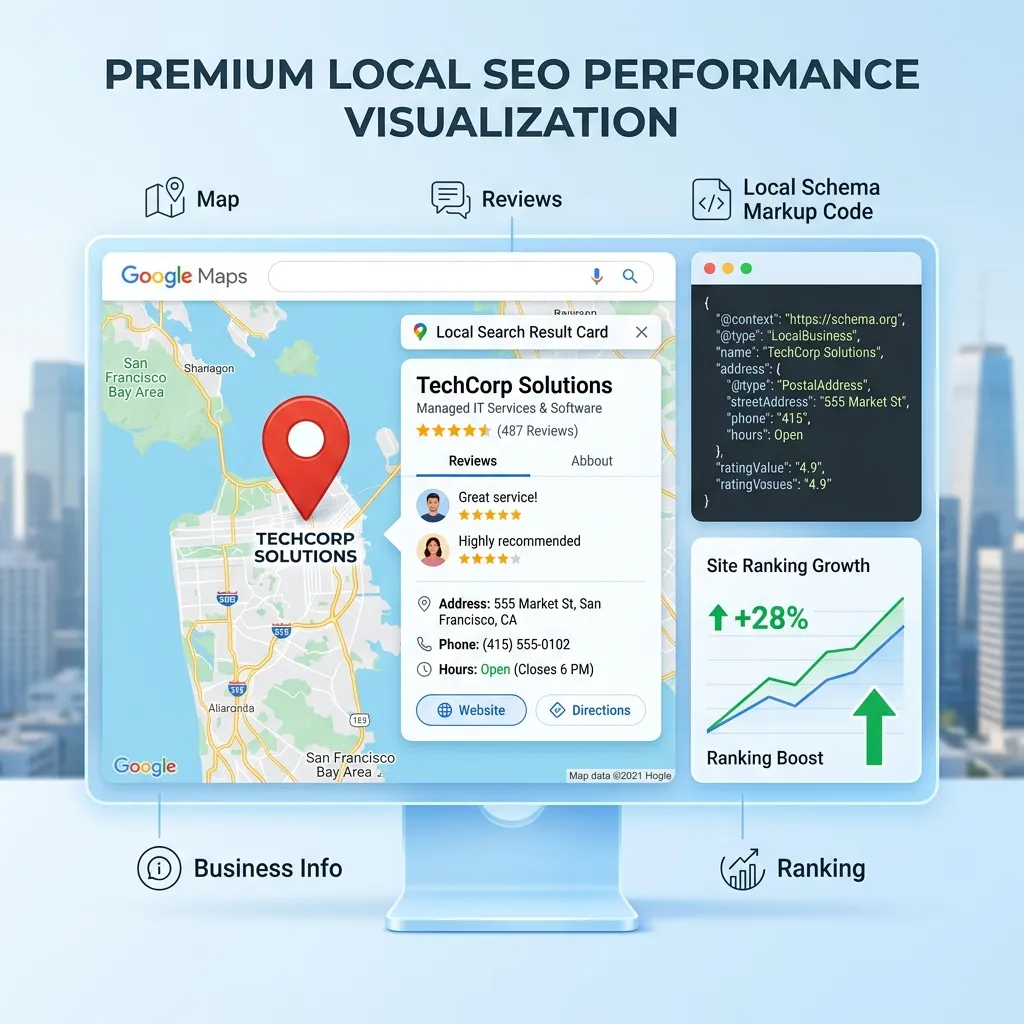
Google Business Profile Optimization Guide 2026: Complete Local SEO Strategy
Learn how to optimize your Google Business Profile for local search rankings in 2026. Complete guide covering verification, posts, reviews, photos, and advanced features for Indian businesses.

Voice Search Optimization for Business: Complete Guide 2026
Learn how to optimize your website and content for voice search — covering natural language queries, featured snippets, schema markup, and local search strategies for AI-powered assistants.
Get Professional AEO / GEO Services
Achieve 48% AI share of voice — optimise content for Google AI Overviews, ChatGPT, Perplexity, and Claude.
